
A Connecticut Guide to Vinyl Fence Installation Cost in 2026
When homeowners in Connecticut consider a new vinyl fence, the first question is always the same: "What will this actually cost me?"
On average, you can expect the vinyl fence installation cost to be between $44 and $70 per linear foot. Most projects we handle land around the $54 mark. So, for a standard 150-foot backyard, your total investment would likely be between $6,600 and $10,500.
What Is the Real Cost of a New Vinyl Fence in Connecticut?
Pricing a new fence is like buying a car. The final cost depends on the model and the features you choose. A simple, four-foot picket fence is like a base model—it looks great and does its job. A six-foot privacy fence with decorative post caps and a matching gate is like a fully-loaded model. It costs more because it uses more materials and requires a more detailed installation.
Your property also plays a big role. A flat, clear yard is straightforward to work with. But if we need to install on steep hills, remove an old fence, or deal with rocky soil, those factors will add to the final cost.
To give you a clearer starting point for your budget, here’s a quick breakdown of what a standard project might look like in Connecticut.
2026 Vinyl Fence Installation Cost at a Glance for Connecticut
This table provides a quick summary of estimated costs for a standard 150-foot vinyl fence project in Connecticut, helping homeowners budget effectively.
| Cost Component | Average Cost Per Linear Foot (Installed) | Estimated Total for 150 ft Project |
|---|---|---|
| Low-End (Basic Picket Fence) | $44 | $6,600 |
| Mid-Range (Standard Privacy Fence) | $54 | $8,100 |
| High-End (Premium Style, Complex Site) | $70 | $10,500 |
These figures provide a solid financial starting point, but it's also helpful to understand why prices are what they are today.
A Look at Historical Price Trends
The cost of fencing changes over time, reflecting larger economic trends in materials and labor. When Connecticut Fence Works, LLC first started installing fences in 2014, the average rate was closer to $25 to $40 per linear foot. The prices we see now are significantly higher for clear reasons.
In 2026, the national median cost for a professionally installed vinyl fence is between $44 and $70 per linear foot, with most projects falling near $54. This increase of nearly 50-75% over the last 12 years is largely due to a 20% surge in PVC resin costs (the raw material for vinyl) between 2020 and 2023 and a 15-25% rise in skilled labor wages.
This infographic gives you a great visual of the typical cost range.
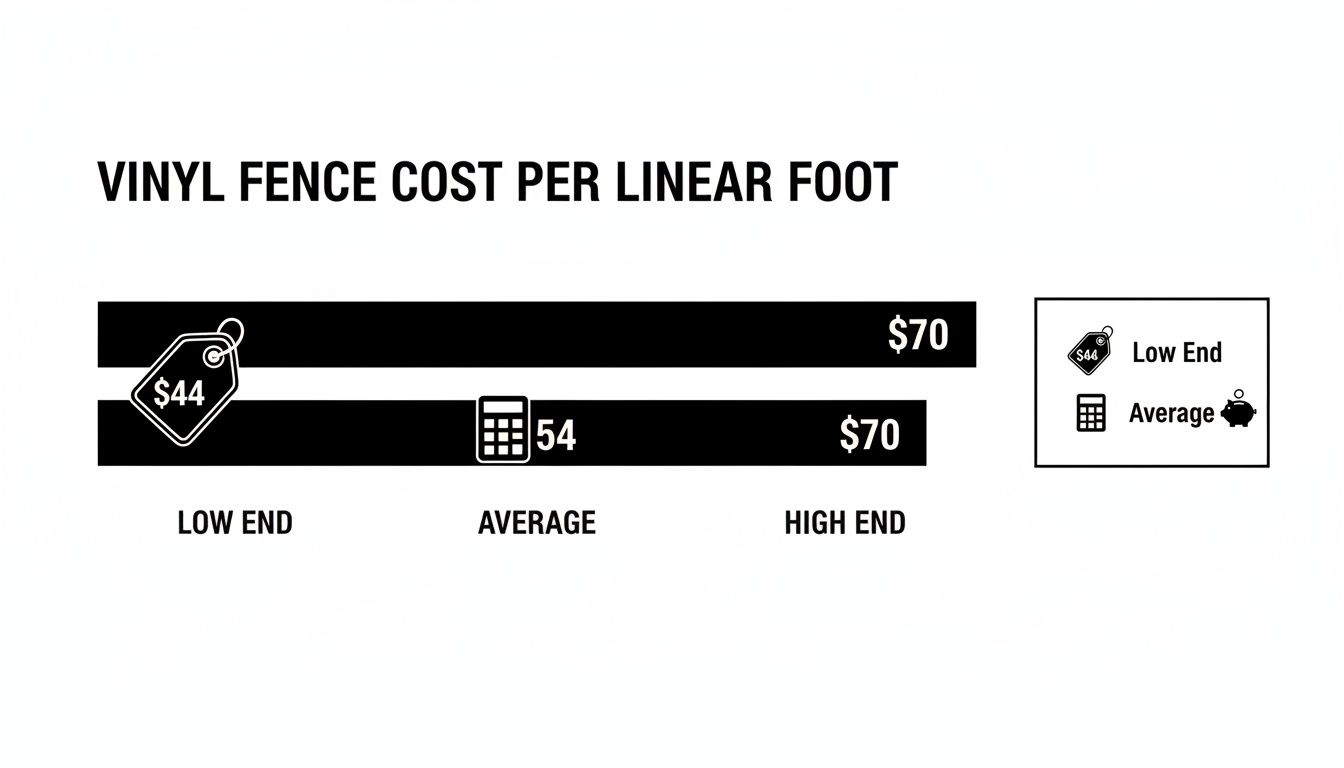
As the data shows, most projects fall near the $54 per foot average, but the final price depends on your specific choices and property. These rising costs make it more important than ever to get a detailed, itemized quote from a professional you trust. You can find a more detailed analysis of these national cost trends to see how all the factors fit together.
Understanding Your Vinyl Fence Estimate
When you first look at a professional fence quote, it can feel a bit overwhelming with different line items and unfamiliar terms. But once you understand how the total is calculated, it all starts to make sense.
Ultimately, your total vinyl fence installation cost comes down to three key areas: the materials, the skilled labor for installation, and any work needed to prepare the site. Understanding these three parts helps you see exactly where your money is going and why professional installation is a valuable investment.
The Materials: More Than Just Plastic
The largest portion of your estimate—usually 40-50% of the total cost—will be the materials. This includes everything from the vinyl fence panels and posts to the rails, caps, and hardware. It’s important to know that not all vinyl is the same, and your choice here greatly affects both the price and the lifespan of your fence.
The most important difference is the quality of the vinyl itself. We use virgin vinyl, which is a premium product made from 100% new materials. It contains protective additives like titanium dioxide (TiO2) to shield it from the sun's harsh UV rays. This is what prevents the fence from yellowing, cracking, or becoming brittle over its 20 to 30-year lifespan.
In contrast, you might find cheaper quotes that use recycled vinyl. While it can save money upfront, recycled materials often don't have the same durability as virgin vinyl. They can fade, warp, or sag over time, especially when facing Connecticut’s cycle of hot summers and freezing winters.
The style of fence you choose also affects material costs. It simply comes down to how much vinyl is needed:
- Privacy Fences: These use solid panels with no gaps and require the most material, placing them at the higher end of the price range.
- Semi-Privacy Fences: With stylish, small gaps between the pickets, they use less material and are a great mid-range option.
- Picket Fences: Classic picket styles use the least amount of material, which generally makes them the most affordable choice.
The Labor: The Value of Craftsmanship
Next is labor, which typically makes up another 30-50% of the project total. It’s easy to think this is just the cost of putting posts in the ground, but professional labor is much more than that. It is the expertise, physical work, and attention to detail that ensures your fence not only looks good on day one but also stands strong for decades.
A common mistake in DIY projects is not setting the posts deep enough. In Connecticut, posts must go below the frost line—typically 36 to 42 inches deep—to prevent them from being pushed up by the ground during winter's freeze-thaw cycle. Our crews use professional-grade power augers to do the job correctly and efficiently.
Professional labor covers all the critical steps that separate a weekend project from a long-term investment:
- A Perfect Layout: We take the time to carefully plan and stake the fence line, ensuring it’s perfectly straight and positioned correctly.
- Setting the Posts: This involves digging every post hole to the right depth and width, then setting each post perfectly level in concrete. This is the foundation of a sturdy fence.
- Panel and Gate Fitting: We carefully cut panels for a seamless fit and hang gates so they swing smoothly and latch securely every time.
- The Finishing Touches: Details matter—from ensuring every post cap is perfectly aligned to a thorough cleanup of the entire worksite.
This is the skilled craftsmanship that makes all the difference.
The Site Prep: Getting the Ground Ready
Finally, preparing your property for the new fence—what we call site preparation—can account for 10-20% of the cost. If your yard is flat and clear, these costs will be minimal or non-existent.
However, most properties in Connecticut have a few challenges that need to be addressed before we can start digging.
Common Site Preparation Work Includes:
- Clearing the Fence Line: We often need to remove overgrown brush, small trees, or other plants to create a clear path for installation.
- Old Fence Removal: If there's an old fence in the way, our team can take it down and haul it away, which covers the labor and any disposal fees.
- Minor Grading: For yards with slopes or uneven ground, some light grading might be needed to ensure the fence follows the land's contours smoothly.
- Dealing with Obstacles: Working around difficult terrain, like the rocky soil found in many parts of Hartford and Litchfield counties, requires special equipment and extra time.
By understanding these three elements—materials, labor, and site prep—you can review any fence estimate with confidence. You’ll see that the total cost reflects the quality materials and expert work required to build a beautiful, durable fence that you’ll enjoy for years.
How Fence Height and Style Affect Your Total Cost
As you finalize your budget, two choices will influence your final price more than anything else: the height and style of your vinyl fence. The general rule is simple: the more material the fence uses and the more complex its design, the higher the vinyl fence installation cost.
But it’s not just about the extra vinyl. A taller fence requires a more demanding installation. For instance, the posts for a six-foot fence must be set deeper in the ground with more concrete to handle wind and remain perfectly straight for years. This is why a six-foot privacy fence will always have a higher cost per foot than a four-foot picket fence.
Comparing Popular Vinyl Fence Styles
Choosing a style is about balancing how you want your fence to look and what you need it to do. Each style has its own price, which is mostly determined by how much vinyl is in each panel.
Solid Privacy Fences: These are the top choice for homeowners who want complete privacy and a noticeable reduction in noise. Because the panels interlock with no gaps, they use the most material, placing them at the top of the price range. They are perfect for backyards, pool enclosures, or properties near busy streets.
Semi-Privacy Fences: If you're looking for a middle ground, semi-privacy is a fantastic option. These designs feature small, stylish gaps between the pickets, creating a more open feel while still defining your property. Since they use less material than solid privacy fences, they fall comfortably in the mid-range for cost.
Picket and Decorative Fences: Nothing captures classic charm like a picket fence. They are ideal for front yards and gardens where you want to create a boundary without blocking the view. They use the least amount of material, making them the most budget-friendly option. We have a great selection of these beautiful and durable vinyl fence options that can enhance your home's curb appeal.
Ultimately, the decision comes down to your main goal. A picket fence adds a welcoming, decorative touch, while a solid privacy fence creates a secure, personal space for your family. Identifying that priority is key to matching your needs with your budget.
Estimated Cost by Vinyl Fence Height and Style (Per Linear Foot)
To give you a clearer picture, let's look at how these factors affect the cost per foot. The following table breaks down typical price ranges in Connecticut based on common styles and heights. Keep in mind these are estimates, and a final quote will depend on your specific property.
| Fence Style | 4-Foot Height | 5-Foot Height | 6-Foot Height |
|---|---|---|---|
| Picket Fence | $40 – $55 | $45 – $60 | N/A |
| Semi-Privacy Fence | $45 – $65 | $50 – $70 | $55 – $75 |
| Solid Privacy Fence | N/A | $55 – $75 | $65 – $80 |
As you can see, choosing a taller fence or a style with more material, like solid privacy, directly increases the cost. A six-foot solid privacy fence can easily cost 15-20% more than a shorter picket or semi-privacy style due to differences in both materials and labor.
To put that in perspective for a typical 150-foot project in Hartford County, a four-foot fence might range from $6,000 to $9,750. If you upgrade that same project to a six-foot privacy fence, the total could climb to between $7,650 and $12,000.
Don't Forget the Gates
Finally, no fence is complete without a gate, and this is an important part of your budget. A standard 4-foot-wide walk gate typically adds $500 to $1,200 to the project. That price includes the gate itself, plus the necessary heavy-duty posts, hinges, and latch built to handle daily use.
If you need a wider opening for a vehicle, a driveway gate is a more significant investment. These larger, often double-panel gates require even stronger posts and more complex hardware to operate smoothly and securely, generally costing between $2,500 and $4,000. Factoring these components in from the beginning helps ensure your budget is realistic and complete.
DIY vs Professional Installation A Realistic Cost Comparison
The idea of installing a vinyl fence yourself can be tempting. When you look at a professional quote, the labor cost can seem like an easy place to save money. On paper, it looks like a simple way to lower your overall vinyl fence installation cost.
But before you start marking your property line and renting equipment, it’s worth taking an honest look at what a DIY project truly involves. While you avoid paying for a professional crew, a DIY job has its own hidden costs that can quickly reduce, and sometimes even eliminate, your expected savings.
The Hidden Costs of DIY Installation
A DIY fence project is more than just buying panels and snapping them together. The reality involves more time, unexpected expenses, and physical effort than most homeowners expect.
Here are some common costs that catch people by surprise:
- Tool and Equipment Rentals: You'll need more than a shovel. Renting a professional-grade power auger to dig post holes can cost $80-$100 per day, and you'll likely need it for a full weekend.
- Material Delivery Fees: Vinyl fence parts are long, bulky, and heavy. Unless you own a large truck, expect to pay several hundred dollars just to get the materials delivered.
- Waste Disposal: What do you do with all the dirt from the post holes or the old fence you removed? You may need to rent a dumpster or pay fees to haul everything to a disposal site.
- The Cost of Mistakes: This is the biggest financial risk. A single measurement error can create a chain reaction of problems.
Imagine you're installing a 150-foot fence. You set your posts and realize—only after the concrete has hardened—that your line is off by a few inches. Now, the standard panels won't fit. Fixing that one mistake means digging up concrete, buying new materials, and re-doing hours of work. Just like that, your savings are gone.
The True Value of Professional Installation
Hiring a professional installer is not just about paying for labor; it's an investment in getting the job done right the first time. You are paying for expertise, efficiency, and a guarantee that protects your investment for years to come. The value a professional crew brings goes far beyond just digging holes.
Here’s what you’re really getting:
- Efficiency: An experienced team has a streamlined process. A project that might take you multiple weekends can often be completed in a few days.
- Specialized Equipment: Professionals arrive with everything they need, from laser levels for perfect lines to powerful augers designed for Connecticut’s rocky soil.
- Guaranteed Quality: You're paying for the skill to get every detail right—from setting posts below the frost line to prevent shifting, to hanging a gate that swings perfectly every time.
- Warranty Protection: This is a major benefit. A professional installation comes with a workmanship warranty. If a post leans or a gate sags a year from now, they will come back and fix it. If you did it yourself, that repair is on your time and your budget.
The DIY versus pro debate is common in home improvement. You can see similar arguments in articles like why hiring a professional sod grass installation service instead of DIY.
Comparing the Timelines and Real-World Costs
When you look at the facts, the difference becomes clear. Our experienced installers at Connecticut Fence Works can typically complete a standard residential fence in 2 to 4 days. A similar DIY project often stretches over 4 to 8 days, taking up multiple weekends and evenings.
The popular idea that you can save 50% by doing it yourself rarely holds up. That calculation often ignores the high cost of voiding material warranties or dealing with fence failure from improperly set posts.
It's also important to remember that prices in the Northeast are already 10-15% above the national average due to our region’s labor costs and terrain. You can explore fence pricing insights on countbricks.com for more on these regional factors. When you factor in the value of your own time, tool rentals, and the security of a professional warranty, the vinyl fence installation cost from a pro is often the smarter long-term investment.
Local Factors That Influence Connecticut Fence Costs
You’ve chosen the perfect fence style and color. But when it comes to your final vinyl fence installation cost, the materials are only part of the story. The biggest factors are often specific to your property and your town here in Connecticut.
Think of it like buying a car. The sticker price is just the start. The real cost depends on where you live—taxes, insurance, and registration fees all vary. Fencing works the same way. Local labor rates, your property's condition, and town regulations all affect your final estimate. Understanding these local details is key to creating a realistic budget.
Navigating Connecticut's Unique Terrain
One of the first things we examine is the ground itself. Connecticut's landscape is beautiful but can be very challenging for installers. In many areas, especially across Hartford, Tolland, and New Haven counties, the ground is filled with rocks.
If your yard has dense, rocky soil, our crew can’t use a standard post-hole digger. We have to bring in heavy equipment—like hydraulic augers or even jackhammers—to set the posts correctly. That extra time, effort, and machinery naturally affects the labor cost in your quote. The same applies to properties on a steep hill or lots that need grading to create a clean, stable fence line.
A fence on a flat, clear lot in Middlesex County may have a lower labor cost than an identical fence on a rocky, sloped property in New London County. The second project requires more time, more powerful tools, and more skill to complete correctly.
Local Permits and Zoning Regulations
Every town in Connecticut has its own set of rules for fences, and they can be very different. One town might have a simple permit process, while another has a long list of zoning laws dictating everything from fence height to its exact distance from the property line.
Here are a few of the local rules we handle for our clients:
- Permit Fees: The cost to get a building permit can range from a small flat fee to a percentage of the entire project’s value.
- Property Line Setbacks: Most towns require a fence to be installed a specific distance inside your property line, which we must confirm before work begins.
- Pool Codes: If your fence will surround a swimming pool, it must meet very strict state and local safety codes for height, gate hardware, and the spacing between pickets.
Our team has years of experience working with building departments across the state. We handle the entire permit process for you, ensuring your project is fully compliant without you having to deal with confusing paperwork.
Homeowners' Association (HOA) Guidelines
If you live in a planned community, you likely have another layer of rules from your Homeowners' Association (HOA). In our experience, HOA guidelines can be even more restrictive than town codes because they focus on maintaining a uniform look throughout the neighborhood.
Common HOA Fence Rules Include:
- Approved Styles: Your HOA might limit you to just one or two specific styles, like a white vinyl privacy fence or a traditional picket fence.
- Height Restrictions: There's almost always a strict limit on how tall your fence can be.
- Color Limitations: You’ll likely be restricted to certain colors, with white being the most common choice for vinyl fences in HOA communities.
We always ask homeowners for a copy of their HOA's architectural guidelines when we prepare a quote. This allows us to design a fence that meets every requirement from the start, avoiding any expensive fixes or disputes later on.
Thinking About the Long-Term Value of Your Vinyl Fence
When looking at quotes for a new fence, it’s easy to focus only on the initial price. But a fence is a long-term addition to your home. The best way to think about the vinyl fence installation cost is to consider its lifetime value. A quality vinyl fence is a "set it and forget it" home improvement—the real savings come from the time and money you don't spend on it later.
Unlike a wood fence that needs constant attention, vinyl is built to last with very little effort. A professionally installed vinyl fence can easily have a lifespan of 20 to 30 years or more. Throughout those decades, its maintenance needs are almost zero.
The True Cost of Ownership: Vinyl vs. Wood
The financial benefit of vinyl becomes clear when you compare it to a traditional wood fence over a decade or two. A new wood fence looks great at first, but it requires an ongoing cycle of expensive maintenance. To prevent rot, warping, and insects, it needs to be stained or sealed every few years.
Vinyl, on the other hand, frees you from that demanding and costly routine. You'll never have to paint, stain, or seal it. A simple rinse with a garden hose is usually all it takes to keep it looking new.
The long-term return on investment for vinyl is remarkable, especially in Connecticut’s humid coastal regions like New Haven and New London Counties where wood is more vulnerable. Vinyl owners can save up to 70% on maintenance over two decades compared to owners of wood fences.
While the upfront cost for a 200-foot privacy fence might be $6,000-$12,000, a wood fence requires annual sealing at roughly $8-$12 per foot. That adds up to $3,200-$4,800 in extra costs every ten years—a cost that vinyl owners don't have. For more on these long-term cost comparisons, you can read a detailed breakdown on CountBricks.com.
Smart Ways to Manage Your Initial Investment
We understand that the upfront cost is a major factor. The good news is you have practical options that can make a beautiful new fence fit more comfortably into your budget.
- Phasing the Project: You don't have to fence your entire yard at once. We can help you create a multi-phase plan. For example, you could secure the backyard for your kids or pets this year, and then complete the front or side yard next year.
- Financing Options: Many of our customers choose to finance their fence. This is a great way to get the secure, durable fence you need now while spreading the cost into predictable monthly payments that work for your household.
Understanding Your Warranty
A solid warranty is the final, crucial piece that protects your investment. It’s your guarantee that both the materials and the installation are built to last. At Connecticut Fence Works, we ensure our projects are backed by two distinct layers of protection.
What to Look For in a Fence Warranty:
- Material Warranty: This protection comes from the manufacturer. It covers product defects like cracking, peeling, or unusual fading from the sun. A long and comprehensive material warranty is a great sign of a high-quality vinyl product.
- Workmanship Warranty: This is our direct promise to you. It covers the quality of the installation. If a post leans or a gate sags because of how it was installed, we will come back and make it right. Even the best materials can fail if not installed properly, and our workmanship warranty provides you with complete peace of mind. And if accidental damage ever occurs, we're always here to help with professional fence repair services.
So, How Do You Get a Real Quote for Your Fence?
You've done your research. You have a good idea of the different styles, heights, and general costs of a new vinyl fence. Now for the most important step: finding out exactly what your project will cost. Getting a firm, accurate quote is what separates a smooth, predictable project from one filled with surprises.
This is where planning ends and action begins. A good quote isn't just a number on paper; it’s a detailed plan for your installation, based on clear communication and a professional evaluation of your property.
Our Simple, No-Pressure Quoting Process
We believe getting an estimate should be easy and transparent. Our process is designed to give you all the information you need, without any high-pressure sales tactics. It’s all about making sure you’re comfortable and confident.
Everything starts when you schedule a free on-site consultation. This isn't just a quick phone call—it’s a visit from one of our fencing experts to your home.
During our visit, we’ll:
- Walk the Fence Line: We'll walk the property with you to understand your goals, whether it's more privacy, a secure yard for your dog, or simply improving your home's appearance.
- Take Precise Measurements: We don't guess. Our specialist will take exact measurements of the proposed fence line and mark the perfect spots for any gates.
- Evaluate the Ground: We take a close look at the terrain. Is there a slope? Rocky soil that requires extra work? Are there shrubs or roots that need to be cleared?
This hands-on approach is the only way to get the full picture. It allows us to see firsthand what the job will actually involve.
An on-site evaluation is what turns a general "ballpark" estimate into a solid, reliable price. It removes the guesswork, ensuring everything from the amount of material needed to the hours of labor is calculated correctly from the start.
Our Promise: Total Clarity and No Hidden Fees
After our visit, you won't get a single, mysterious number. Instead, we’ll provide you with a detailed written quote that breaks everything down. You’ll see a clear, itemized list of material costs, labor, any site preparation, and permit fees. We are committed to being completely upfront so you never have to worry about a surprise charge on your final bill.
This final quote puts you in control. With a detailed breakdown in hand, you have the concrete information you need to make the right decision for your home and budget. When you're ready to find out what your project will truly cost, you can easily request your free estimate online to get started.
When you're ready to transform your property with a beautiful and durable vinyl fence, trust the local experts who have been serving your neighbors since 2014. Contact Connecticut Fence Works, LLC today to schedule your free, no-obligation consultation and see what we can do for you.