
Expert Security Fence Installation Guide
Investing in a professional security fence installation is more than just a budget item for your Connecticut home or business. It's one of the most effective steps you can take to protect what matters most. This guide will walk you through the process, explaining how a security fence serves as your property's first and most important line of defense.
Why a Professional Security Fence Is a Game-Changer
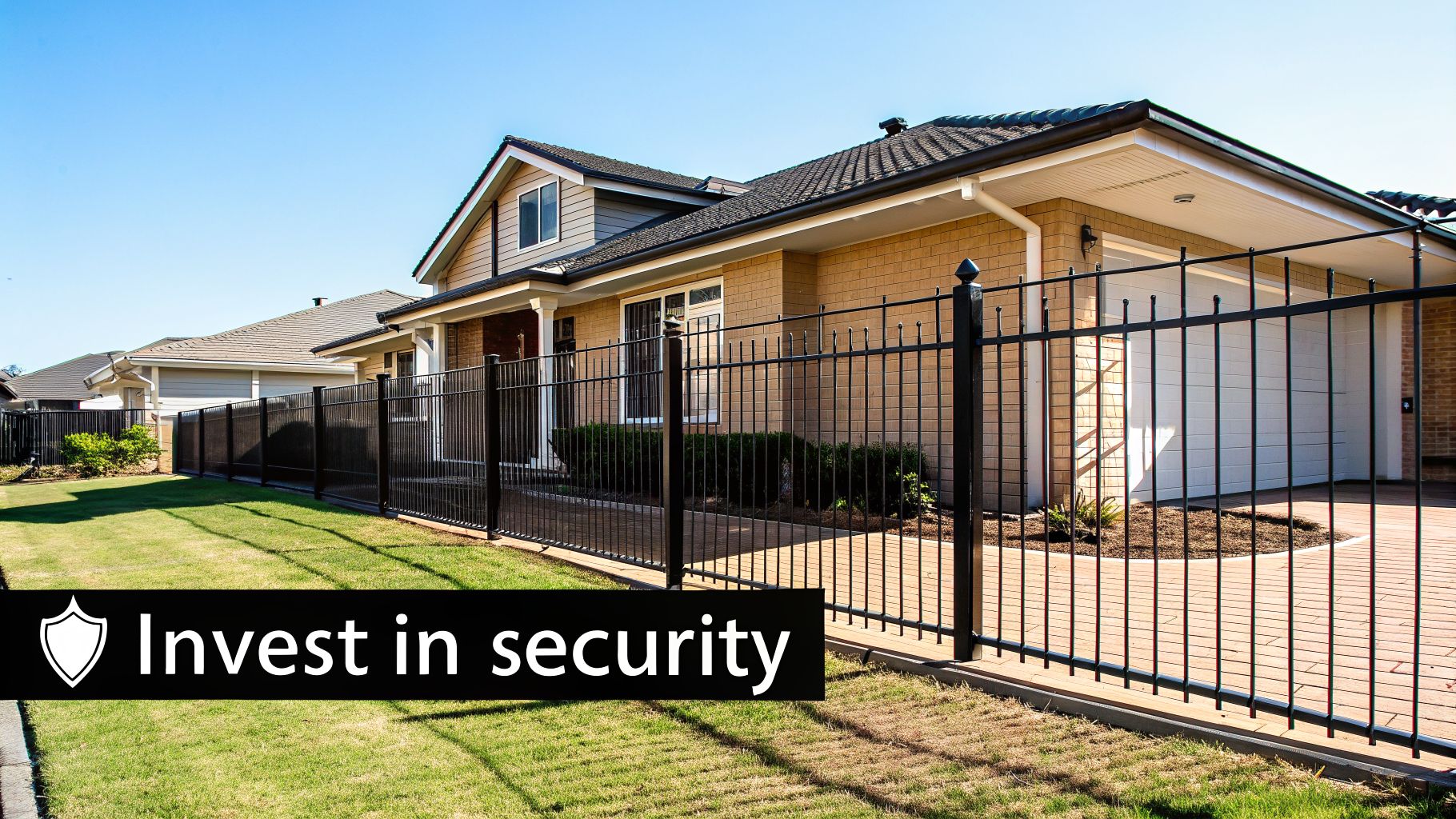
When you think of a "fence," you might picture a simple white picket or split-rail boundary marker. A true security fence, however, is a different category altogether. It is a system engineered to do three things: discourage, delay, and deny entry to unauthorized individuals.
It’s like the difference between a flimsy screen door and a solid steel one. While both mark an entrance, only one offers real protection. A professionally installed security fence is the foundation of any solid property protection strategy. It sends a clear message that your property is secure, which is often enough to deter a potential intruder from even trying.
To better understand its value, let's look at the direct benefits of having a security fence professionally installed.
Key Benefits of Professional Security Fence Installation
This table summarizes the core advantages you gain when you invest in a professionally installed security fence for your Connecticut property.
| Benefit | Impact on Your Property |
|---|---|
| Visual Deterrence | The imposing presence of a robust fence often stops trespassers before they even try, signaling that your property is a hard target. |
| Perimeter Control | A fence forces all foot and vehicle traffic through specific entry points (gates), giving you complete control over who enters your property. |
| Enhanced Safety | Protects children and pets from wandering into traffic and keeps your commercial assets, inventory, and employees safe from external threats. |
| Increased Property Value | A high-quality, permanent security feature is an attractive selling point that can boost your property's market value and curb appeal. |
| Peace of Mind | Knowing your property is physically secured by a tough, reliable barrier provides an invaluable sense of safety and confidence. |
In short, these benefits work together to create a comprehensive security posture that starts right at your property line.
The Core Benefits of a Security Fence
At its heart, good security is about creating layers. A high-quality fence is your outermost—and arguably most important—layer. It acts as both a physical and psychological barrier, immediately establishing control over who can access your space.
- Deterrence: We can't emphasize this enough: the mere sight of a formidable fence is a powerful deterrent. A tall, sturdy fence suggests the property is not only hard to enter but is also likely protected by other security measures.
- Access Control: By its nature, a fence directs everyone through designated gates. This is essential for managing access, whether you're monitoring visitors at home or controlling deliveries and employee access at a business.
- Increased Safety: For families, a fence is crucial for keeping children and pets safely in the yard. For businesses, it protects valuable equipment, inventory, and your team from theft and other dangers.
A well-built security fence does more than just mark a boundary. It establishes a secure perimeter that actively defends your assets and gives you priceless peace of mind.
A Smart Investment for Connecticut Properties
From the quiet suburbs of Fairfield County to the bustling commercial zones around Hartford, property owners are seeing a clear return on their investment in high-quality security fences. It’s a one-time upgrade that provides years of confidence and safety. For temporary needs like construction sites or local events, integrating solutions like temporary CCTV hire can work alongside physical fencing to create a complete security system.
In the following sections, we'll cover everything you need to know—from choosing the right materials to understanding the installation process. Our goal is to provide the expert insights you need to make a confident, informed decision that secures your property for years to come.
So, what really separates a standard fence from a true security fence? It’s a question we get all the time. The simple answer is intent. A regular fence might keep your dog in the yard or mark your property line, but a security fence is a system built specifically to stop, or at least seriously delay, an unwanted person from getting onto your property.
Think of it this way: a picket fence is a suggestion to stay out. A security fence is a command. Every element—from its height to its materials—is chosen to create a strong, active barrier. Opting for a security fence installation isn't just an upgrade; it's a fundamental shift in how you protect your home or business.
Height: Your First Line of Defense
The first thing anyone notices about a security fence is its height, and for good reason. A four-foot fence can be easily hopped over. But when faced with an eight-foot wall of steel, the casual thought of crossing it becomes a serious calculation of risk and effort.
In Connecticut, most residential security fences start at six feet. For commercial sites, we almost always recommend eight feet or higher. It’s not just about the physical difficulty of climbing. The extra height makes an intruder far more exposed, and that visibility is often a powerful deterrent on its own.
A security fence isn't just a barrier—it’s a complete system. Height, materials, and smart design all work together to create a protective shield that actively discourages and physically delays anyone trying to get in.
Anti-Climb & Anti-Breach Design
Height is a great start, but a determined person will always look for a way over or through. That’s where smart, "anti-climb" design features come into play, which are an essential part of any serious security fence installation.
- No Easy Grips: A standard chain-link fence offers a perfect ladder of handholds and footholds. High-security welded wire mesh, on the other hand, has openings so small you can’t even get your fingertips in.
- Purposeful Picket Design: With ornamental steel or aluminum, the vertical bars (pickets) are not just for looks. They are often smooth, spaced tightly, and topped with intimidating spear points. Trying to grab and pull yourself over a spear-topped rail is a dangerous and difficult task.
- Toppers That Mean Business: For an added layer of deterrence, many fences incorporate toppers like angled arms for barbed or razor wire (more common in commercial settings) or sharp, pressed-point pickets. This makes climbing over the top a serious, and often painful, mistake.
The Importance of Robust Materials
A security fence is only as strong as its weakest link. If someone can cut through it with bolt cutters or simply kick a panel in, it’s not doing its job. The materials must be tough enough to withstand a real-world attempt to break through.
That’s why we work with heavy-gauge steel, high-tensile aluminum, and thick welded wire. These materials are chosen for their ability to resist cutting, impact, and prying. But the panels are only half the story. A proper security fence installation means setting the posts deep into the ground and securing them with concrete footings. A fence that can be pushed over is useless. This solid foundation holds the entire system together, creating a barrier that cannot be easily defeated.
Choosing the Right Fence Materials and Design
Picking the right material for your security fence installation is the foundation of your entire security plan. It's like choosing tires for a vehicle; you wouldn't put street tires on a truck built for rugged, off-road terrain. The same logic applies here. You cannot expect a purely decorative fence to provide high-level security.
This decision is especially important here in Connecticut, where our fences must withstand everything from humid summers to deep freezes and heavy snow. The right material needs to do more than just look good. It must fit your budget, provide the level of security you need, and endure our demanding New England weather year after year. Let’s break down the best options for local homes and businesses.
Ornamental Steel for Strength and Elegance
When you need serious security without sacrificing appearance, ornamental steel is in a class of its own. It offers a timeless, commanding look that instantly enhances a property while creating a genuinely tough barrier. Its strength comes from heavy-gauge steel that is engineered to resist cutting, bending, and impact.
This is the perfect choice for properties where a strong visual deterrent is just as important as the physical one—think of a corporate headquarters, a private school, or a high-end residential community. The pickets are notoriously hard to grip, and designs often include pressed-spear tops that make climbing practically impossible.
Ornamental steel combines timeless visual appeal with serious protective strength. It’s an investment in a fence that not only secures your property but also elevates its appearance for decades.
Welded Wire Mesh for High-Security Applications
For properties where security is the absolute top priority, welded wire mesh is the modern standard. Do not confuse this with standard chain link. This material is built with small, tightly-welded grid patterns, making it incredibly difficult to cut with hand tools or climb. The openings are usually too small to get a finger or toehold, which neutralizes one of the most common ways intruders try to breach a fence.
Welded wire is the ideal solution for:
- Commercial Properties: Protecting valuable inventory, data centers, or sensitive equipment.
- Public Utilities: Securing electrical substations and communications infrastructure.
- Government Facilities: Creating a robust, anti-breach perimeter where failure is not an option.
While its look is more industrial, its see-through design is a huge security benefit. It completely eliminates hiding spots and gives you clear, unobstructed lines of sight for surveillance cameras. This allows your fence to work in coordination with your other security systems.
Chain Link Fences: A Versatile and Functional Solution
There's a reason chain link is one of the most recognizable fences out there. It’s affordable, tough, and incredibly versatile, which is why it remains a popular choice for both homes and businesses. A basic chain link fence does a great job of marking a boundary, but its real strength lies in how easily it can be upgraded for security and privacy.
By weaving in privacy slats, you can quickly transform the open mesh into a solid visual screen, blocking prying eyes from your backyard or commercial lot. You can also choose a heavier gauge of wire and smaller mesh diamonds to make it significantly harder to cut. To see just how adaptable this material can be, you can learn more about how modern chain link fences provide both function and security.
To help you visualize how these materials stack up, here’s a quick comparison based on what we see with properties across Connecticut.
Comparing Security Fence Materials for CT Properties
| Material | Security Level | Durability & Maintenance | Best For |
|---|---|---|---|
| Ornamental Steel | High | Excellent; minimal maintenance with powder coating to prevent rust. | Upscale residential homes, commercial properties, and HOA communities. |
| Welded Wire Mesh | Very High | Excellent; galvanized and coated to resist weathering and tampering. | Industrial sites, data centers, airports, and critical infrastructure. |
| Chain Link with Slats | Medium-High | Good; galvanized material resists rust. Slats may need occasional cleaning. | Large backyards, commercial lots, schools, and budget-conscious projects. |
Ultimately, choosing the right material means matching its strengths to your property's specific vulnerabilities and your long-term goals.
Designing for Maximum Security
Beyond just picking a material, the design itself plays a huge role in how effective your fence will be. A true anti-climb design is about more than just height—it’s about thoughtfully eliminating any potential handholds and footholds. That could mean spear-topped pickets on a steel fence or the tight, no-grip grid of a welded wire system.
Finally, think about how the fence will integrate with your property’s layout and existing security measures. A solid privacy fence might be perfect for a secluded backyard, but a see-through design that allows for camera monitoring could be a much smarter choice for a front-facing commercial property. The key is to match the material and design to your specific goals to create a barrier that truly works for you.
Your Step-By-Step Installation Guide
A professional security fence installation is what transforms a simple boundary marker into a genuine layer of protection for your property. It’s about more than just digging holes and hanging panels; it’s a craft that combines precision, planning, and a deep understanding of the local environment. Let's walk through what a proper installation looks like, from the first conversation to the final walk-through.
The entire project begins with a detailed site assessment. This is where an experienced fencing professional visits your property to walk the planned fence line with you. We will take precise measurements, but more importantly, we will evaluate the terrain for any challenges—slopes, tricky corners, mature trees, or rocky soil that could affect the job. We will also locate property lines and discuss your specific security goals.
This initial meeting is crucial. An experienced eye can spot a potential issue, like a steep grade that requires a stepped fence design or a wooded area that needs clearing, long before it becomes a costly surprise. This consultation is the foundation for an accurate quote and a smooth project.
The Critical Pre-Installation Phase
With a solid plan in place, we move into preparation and compliance. This is the behind-the-scenes work that ensures your fence is built legally, safely, and correctly. This is often where DIY projects go wrong.
Here’s what needs to happen before a single post hole is dug:
- Verifying Local Codes: Every town in Connecticut has its own rules about fence height, materials, and placement (setbacks). A professional contractor stays current on these local ordinances to make sure your fence design is fully compliant.
- Securing Permits: Many security fences, especially those over a certain height or on commercial properties, will require a building permit. Your contractor should handle this entire process, submitting the necessary plans to the town building department for approval.
- Utility Line Marking: Before any digging, state law requires a call to 811, the "Call Before You Dig" service. It’s a free service where utility companies come out to mark the location of underground gas, water, and electrical lines. This step is non-negotiable and prevents what could be a dangerous and expensive accident.
These preliminary steps are absolutely vital. While this guide focuses on fences, the principles of a well-planned installation are universal. Understanding the details of a professional security system installation can also be beneficial, as it highlights the same need for expert planning and execution.
This flowchart breaks down the major steps in a professional fence installation.
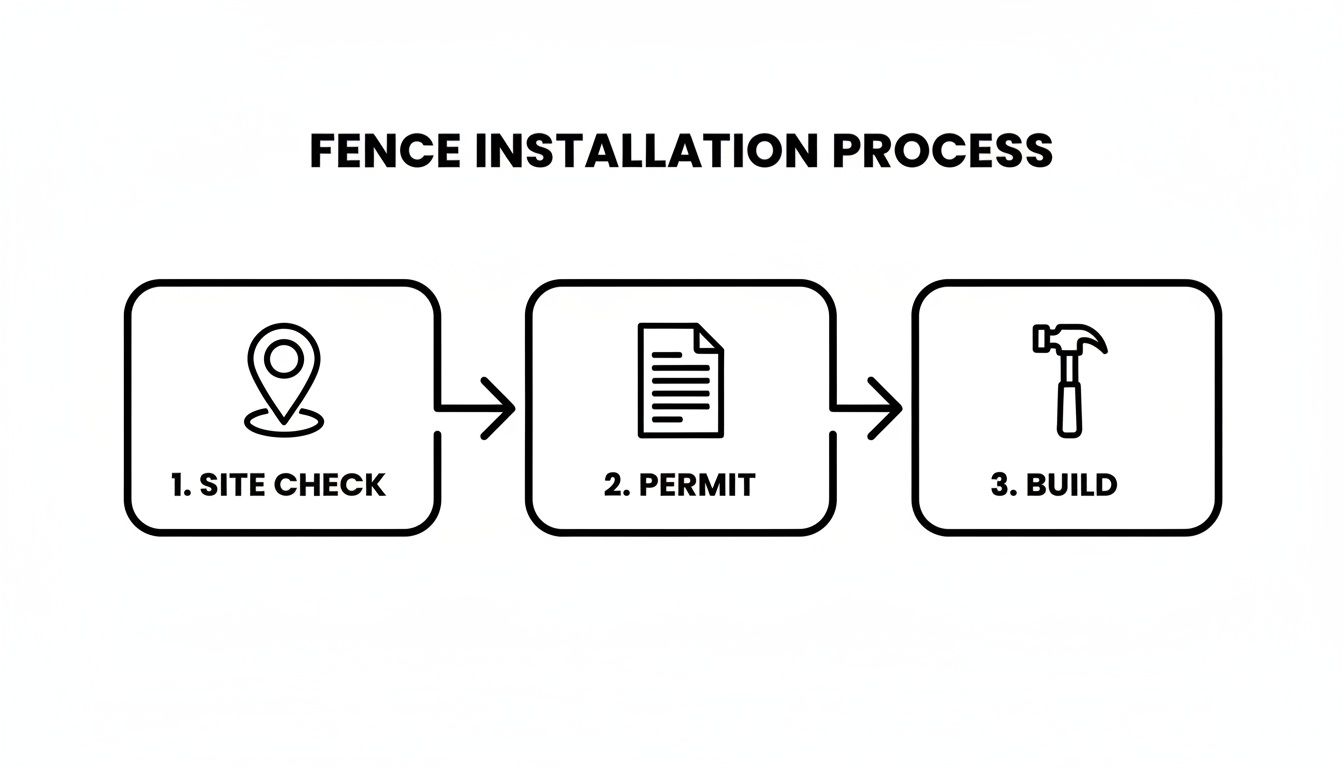
As you can see, a successful build is the direct result of diligent site checks and proper permit handling.
The Physical Build and Realistic Timelines
Once all preparations are complete and permits are approved, the physical installation can begin. This is where the crew’s skill really shows. They’ll start by precisely laying out the fence line with stakes and string, ensuring every run is perfectly straight and every post location is exact.
The single most important part of the build is setting the posts. Your fence posts are the backbone of the entire structure. For a fence to last in our climate, the posts must be set deep into the ground—well below Connecticut’s frost line to prevent shifting during the winter—and anchored securely in concrete footings. This creates an unshakeable foundation that can stand up to high winds, harsh weather, and any force applied to it.
A fence is only as strong as its posts. Setting posts in concrete below the frost line is not just a best practice; it is the only way to ensure your security fence remains straight, strong, and stable for decades.
After the concrete has fully cured, the crew will attach the fence panels or stretch the chain-link fabric, making sure everything is level, taut, and properly secured. Finally, gates are hung, balanced, and adjusted so they swing smoothly and latch correctly every time. A typical residential security fence installation might take anywhere from 2 to 5 days, depending on the length of the fence and the complexity of the job.
The need for better property protection has made fencing a rapidly growing industry. The U.S. market hit $10.5 billion in 2024, and it continues to expand, driven by security concerns here in the Northeast. With data showing property crimes dropping by 12% in fenced communities, a professional installation isn't just an expense—it's a smart, data-backed investment in your safety and peace of mind.
Maintaining and Upgrading Your Fence
Once your new security fence is installed, it's not a 'set it and forget it' part of your property. Think of it as a long-term part of your home or business's defense, and like any important feature, a little preventative care goes a long way. Proper maintenance protects your initial investment, while a few key upgrades can turn a simple barrier into a smart, fully integrated security system.
It's a lot like owning a car, especially here in Connecticut. You get regular oil changes to keep the engine healthy and check the tires to stay safe on the road. A quick seasonal inspection of your fence can catch small issues—like a loose post after a winter frost—before they become expensive problems. This simple diligence ensures your security fence installation continues to provide real peace of mind for years.
Practical Maintenance for Lasting Performance
The maintenance your fence needs depends on the material you chose, but the goal is always the same: spot trouble before it gets worse. For steel and aluminum, the factory powder coating is incredibly durable, but you should still walk the fence line occasionally to check for deep scratches or chips that could expose the metal to rust.
With a chain link fence, the main thing to watch for is proper tension; you do not want to see it sagging between posts. For any type of fence, pay close attention to the gate hardware. A sagging gate or a latch that doesn’t quite catch isn't just an annoyance; it’s a weakness in your security.
A well-maintained fence is an effective fence. The single best thing you can do is walk the perimeter after a big storm to ensure your barrier is still strong, stable, and ready to do its job.
Upgrading Your Fence to an Active Security System
A fence on its own is a great physical deterrent. But the real power comes from pairing it with technology, turning a passive boundary into an active, responsive security asset. These upgrades give you far more control and awareness over your property.
Here are the most popular and impactful upgrades we see clients choose:
- Automated Gates and Access Control: This is easily the most common and powerful upgrade. Instead of dealing with a padlock in the rain, an automated gate with a keypad, card reader, or remote lets you manage who comes and goes. A Hartford business, for example, can give employees unique codes for after-hours access, creating a perfect digital log of entry.
- Motion-Activated Lighting: Intruders prefer darkness. Installing motion-activated lights along your fence line takes away that advantage. When a bright floodlight suddenly kicks on, it not only startles a potential trespasser but also makes them highly visible to neighbors and security cameras.
- Integrated Security Sensors: Modern systems offer sensors that attach directly to the fence itself. These smart devices can detect vibrations from climbing, cutting, or tampering, and instantly trigger an alarm or send an alert to your phone. It effectively turns your entire perimeter into a live, monitored tripwire.
Making Smart Choices for Your Property
The right upgrades are the ones that solve your specific security challenges. A homeowner in a quiet New Haven suburb might find an automated gate and smart lighting perfect for making nighttime arrivals feel safer. On the other hand, a commercial facility manager with a large equipment yard would likely prioritize integrated sensors for immediate breach alerts after business hours.
By thinking strategically about these add-ons, you can multiply the value of your initial investment. If you do notice signs of wear like rust, loose posts, or damage, getting it fixed quickly is critical. For a better understanding of what to look for, exploring professional advice on common fence repair scenarios can help you decide on the best way to restore your fence’s integrity.
How to Choose the Right Fence Contractor
Let's be direct: the best fence materials in the world will fail if the installation is poor. Your security fence installation is only as good as the team putting it in the ground. This makes choosing the right contractor the single most important decision you'll make.
Think of it like hiring a mechanic for a prized car. You wouldn't let just anyone under the hood; you'd want a specialist who understands that specific engine. Your fence contractor is that specialist for your property, and finding a great one means knowing what to look for.
The Non-Negotiables: Licenses and Insurance
Let’s get this out of the way first, because it's the most critical checkpoint. A legitimate contractor in Connecticut must have a valid Home Improvement Contractor (HIC) license, along with proof of both liability insurance and workers' compensation. This isn't just red tape—it's your protection against risk.
- Licensing: An HIC license is the baseline. It proves the contractor is a registered, accountable business in the eyes of the state. If they don't have one, move on.
- Liability Insurance: What happens if their equipment accidentally damages your driveway or a neighbor’s property? This insurance covers it. Without it, that bill could land on you.
- Workers’ Compensation: If a crew member is injured while working on your property, this protects you from being held liable for their medical bills. It’s a huge, often overlooked, financial safeguard.
Always ask to see physical copies of their license and insurance certificates. A true professional will have them ready without hesitation. It’s a sign they run a serious, responsible operation.
Proof Is in the Portfolio: Local Work and Experience
A slick brochure is one thing, but seeing finished work is another. Ask to see a portfolio, but don't just look at the pretty pictures. Focus on projects that are similar to yours. Are the fence lines perfectly straight? Is the hardware installed cleanly? Do the gates hang properly?
Better yet, ask for addresses of recent installations in your town or a neighboring one. A quick drive-by gives you an unfiltered look at their craftsmanship and how it holds up in the real world. A contractor with a deep local portfolio, especially one that includes both residential and commercial fence installation, demonstrates they know how to handle Connecticut's unique terrain—from our rocky soil to specific town zoning codes.
Expert installation isn't just about looks; it's a tangible investment. Professionally installed fences can boost property values by 7-10%, and fences that meet pool safety codes have been shown to reduce child drownings by up to 50% in states with compliance laws. Learn more about the historical impact of professional fence building on WTOP.com.
Reading Between the Lines: Reviews and Contracts
Online reviews on platforms like Google provide a window into a company's day-to-day operations. Look for patterns. Do customers repeatedly mention good communication, a punctual crew, and a thorough cleanup? That’s a good sign. A few negative reviews aren't necessarily a dealbreaker, but pay close attention to how the company responded. Their reply reveals a lot about their accountability.
Finally, never move forward without a detailed, written contract. This document is your project's blueprint. It must clearly specify the exact materials, total cost, payment schedule, and an estimated timeline. A thorough contract protects both you and the contractor, ensuring everyone is on the same page before the work begins.
Answering Your Final Questions About Security Fencing
Once you've settled on the right materials and design, a few practical questions almost always come up. That's completely normal. Let's walk through the common questions we hear from homeowners and business owners across Connecticut to give you the last bit of clarity you need.
How Much Does a Security Fence Actually Cost in Connecticut?
This is usually the first question people ask, and the honest answer is: it depends. The final price is a mix of a few key factors. The total length of the fence is the biggest driver, followed by the material you choose—ornamental steel will naturally cost more per foot than standard chain link. The fence height and the complexity of your property, like dealing with slopes or rocky soil, also play a role.
To give you a realistic starting point, a professional installation typically ranges from $25 to $75+ per linear foot. The only way to get a firm number, though, is with a custom quote for your specific property.
What's a Realistic Timeline for Installation?
From our first handshake to the final walkthrough, a standard residential security fence project usually takes about 1 to 2 weeks. That timeline covers the initial site assessment, calling 811 to have public utilities marked ("Call Before You Dig"), and the actual installation work, which itself often takes just 2-5 days.
The main things that can extend this timeline are waiting on permit approvals from your specific town and, most importantly, allowing concrete post footings to cure properly. That’s a crucial step that cannot be rushed.
Can a Fence Be Installed in the Winter?
Yes, absolutely—with a few exceptions. We can and do install fences during the Connecticut winter, as long as the ground isn't frozen solid and we aren't fighting a blizzard. Experienced crews are equipped to handle the colder weather.
In fact, winter can be a strategic time to schedule your project. Contractor schedules are often more open, which can sometimes work to your advantage.
How Do I Know if I Need a Permit?
Permit rules are set at the local level, so what's required in Greenwich might be different from Glastonbury. You will almost certainly need a permit if your project involves:
- A fence over a certain height, which is often 6 feet for security or privacy fences.
- Any fence on a commercial property.
- A fence enclosing a swimming pool, which is subject to very strict safety codes.
The best approach is to work with a reputable local contractor. They will know the codes in the towns they serve and will typically manage the entire permit application process for you, removing that headache from your plate.
A well-built perimeter fence is more than just a boundary line; it's a proven deterrent that can reduce property intrusions by up to 80%. For pool owners, a code-compliant fence is even more vital, preventing over 70% of accidental drownings.
Ready to secure your property with a fence built to last? The team at Connecticut Fence Works, LLC has been delivering superior residential and commercial fencing solutions since 2014. Get your free, no-obligation estimate today.