
A Homeowner’s Guide to Iron Fence Repairs in Connecticut
Iron fences need a little care now and then, especially with the wear and tear from weather and age. Common issues like rust, peeling paint, or a wobbly post can often be fixed without tearing everything down. Catching these problems early is the key to a simple repair that restores your fence's strength and classic good looks.
Diagnosing Common Iron Fence Problems in Connecticut
Your iron fence is a major investment in your property’s security and appearance. But here in Connecticut, our weather throws everything it has at it—from humid, salty summer air along the coast to the punishing freezing and thawing cycles of winter. Learning to spot the early warning signs of trouble is the first step in protecting that investment.
Think of it as being a fence detective. A quick walk along your fence line a few times a year is all it takes to spot the clues. Addressing them right away can mean the difference between a simple fix and a major structural headache down the road.
The First Sign of Trouble: Rust and Corrosion
Rust. It’s the number one enemy of any iron fence. The trouble starts the moment the protective paint gets scratched or worn away, exposing the raw iron to moisture and oxygen. In Connecticut, this process gets a serious boost from our high humidity, coastal salt spray, and the road salt used all winter.
At first, you’ll probably just see a fine, orange-colored dust on the surface. Pay close attention to joints, welds, and the bottoms of pickets where water likes to collect. This is surface rust, and catching it now is the best-case scenario. If you let it go, the damage gets more aggressive:
- Flaking or Scaling: The rust starts to push the paint up, creating a scaly, peeling texture as it eats into the metal.
- Pitting: You'll begin to see small holes or pits forming on the iron’s surface, a sign that the corrosion is digging in deeper.
- Structural Rust: This is the point where the damage becomes severe. The rust has eaten completely through the metal, creating holes and making entire sections thin, brittle, and unsafe.
When you see that first dusty orange film, that's your cue to act. It's the easiest and cheapest time to make a repair.
When Paint Begins to Fail
A high-quality paint job isn't just for looks; it's your fence's armor against the weather. Once that armor is broken, the fence is left vulnerable. Keep an eye out for the clear signs of a problem.
A failing paint coat is like a crack in a dam. It might seem small at first, but it allows damaging moisture to get through, leading to much bigger problems down the line.
The most common signs of paint failure are bubbling, blistering, peeling, or cracking. You’ll often find these issues in spots that hold moisture or get blasted by direct sunlight day after day. Bubbling, for example, is a classic sign that moisture is trapped under the paint, pushing it away from the metal and creating the perfect hidden environment for rust to grow.
Identifying Structural Weakness
The trouble doesn't stop at the surface, though. It’s just as important to check for issues that weaken the fence’s stability, especially with the posts and gates that handle the most stress. A wobbly post or a sagging gate isn't just an eyesore—it’s a clear signal that the foundation is failing.
Go ahead and give your fence posts a firm push. They should feel completely solid. If a post has any give, its concrete footing has likely cracked. This is often caused by frost heave—a very common problem in Connecticut where the freezing and thawing ground literally pushes posts upward out of the ground.
Next, check your gate. Does it swing open smoothly, or does it drag on the driveway? A sagging gate is often the result of a leaning post or hinges that are simply worn out from use. Seeing how a properly installed and maintained fence should look can help you spot these problems, so take a look at some examples in our project gallery.
Mastering the Methods of Iron Fence Repair
Once you’ve spotted the trouble signs on your iron fence, the next step is understanding how a true professional actually fixes them. Proper iron fence repairs are much more than a quick patch job. They involve specific, proven techniques meant to bring back both the fence's strength and its good looks. When you know what goes into a quality repair, you can spot a job well done.
It’s an important topic, especially now. With security and curb appeal on everyone’s mind, people are investing in fences that last. You can see it in the numbers—the metal fencing market was valued at USD 31.45 billion in 2024 and is expected to climb to USD 57.8 billion by 2035. That’s a clear sign that property owners are choosing to maintain their investments rather than replace them.
This simple diagnostic chart shows the three most common issues that send people looking for repairs.
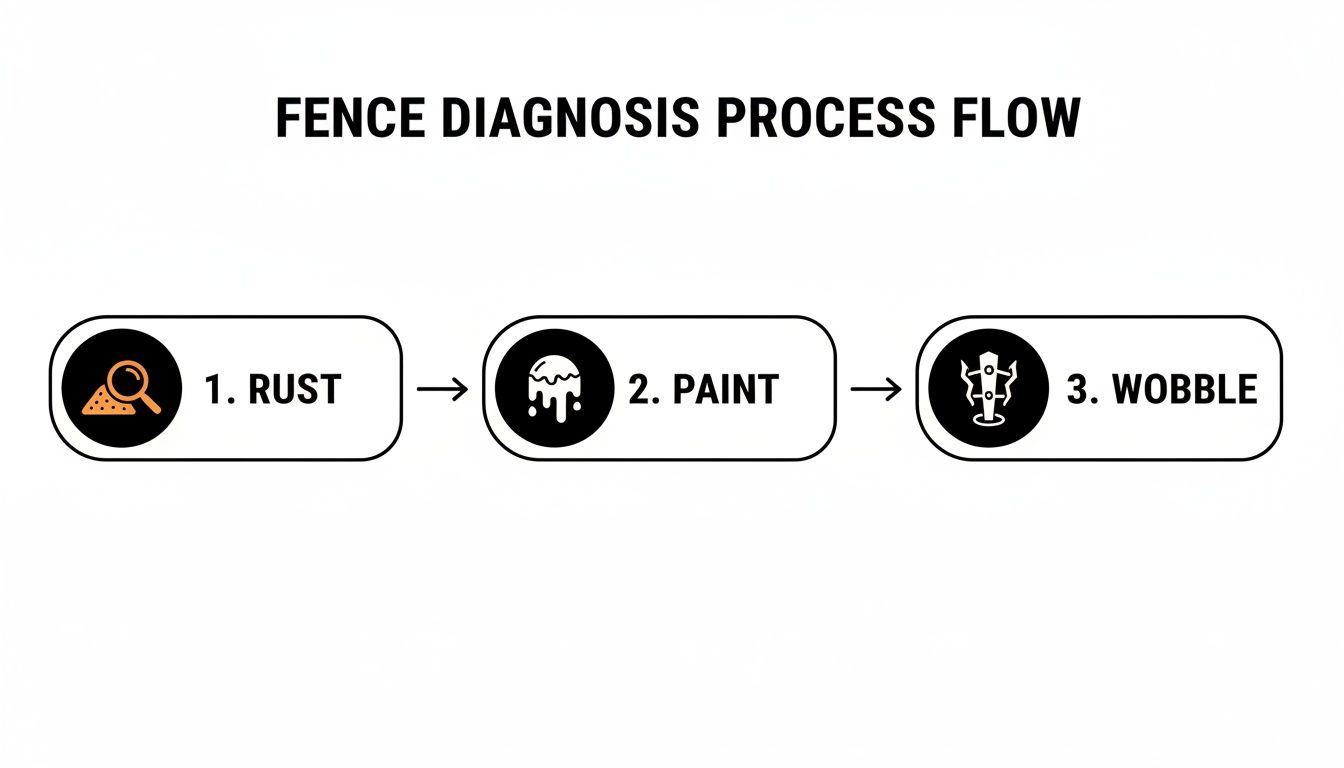
As you can see, most issues start with rust, failing paint, or a bit of a wobble. Each one needs its own specialized fix.
The Art of Professional Rust Treatment
Slapping a coat of paint over rust is like putting a small bandage on a deep wound—it hides the problem for a little while, but it doesn't actually heal anything. Real rust removal is a careful process designed to stop corrosion completely and create a finish that will last for years, not just a season.
Here’s how it's done correctly:
- Aggressive Removal: First, all the loose rust and peeling paint have to go. Professionals use tools like wire wheels, grinders, or even sandblasters to get the surface down to clean, bare metal.
- Chemical Conversion: With the heavy cleaning done, a specialized rust converter is applied. This isn't paint; it's a chemical that reacts with any remaining microscopic rust, transforming it into a stable, black, and paintable surface. It literally stops the corrosion process.
- Priming and Sealing: The final step is to apply a high-quality, rust-inhibiting primer to seal the metal from air and moisture. This is followed by one or more topcoats of industrial-grade paint, creating a tough, protective barrier against the elements.
This is the only way to guarantee that rust won't bubble up again in a few months. It's the difference between a temporary patch and a true, long-term solution.
Restoring Strength with Welding Repairs
When an iron fence has broken pickets, cracked rails, or snapped decorative elements, welding is the only real answer. It’s a craft that, in the right hands, makes the repaired area just as strong—if not stronger—than the original metal.
Think of it as a kind of metal surgery. A skilled welder isn't just gluing parts together. They use intense heat to literally melt the broken pieces back into one, creating a seamless and permanent bond. This is crucial for fixing impact damage, whether from a falling tree branch or a bump from a car. The welder will grind the edges for a clean fit, align everything perfectly, and create a weld that’s both strong and neat.
After the weld cools, it’s ground down smooth to blend in with the surrounding metal before being primed and painted. When an expert does it, you often can't even tell a repair was made. This incredible durability is one of the biggest benefits of ornamental metal fencing, since it can be repaired instead of completely replaced.
Stabilizing Wobbly Posts and Sagging Gates
A fence is only as sturdy as its foundation. Here in Connecticut, the winter freeze-thaw cycle can cause "frost heave," pushing posts right out of the ground. Over time, this leads to leaning fence lines and sagging gates. Fixing a wobbly post isn’t about just pushing it straight; it’s about correcting the problem underground.
A wobbly post is a clear signal that the fence's foundation has failed. A professional repair addresses the root cause below the ground, not just the visible symptom above it.
This is how a professional gets to the bottom of it:
- Assessment: The first step is to dig around the post to see what’s going on with its concrete footing. A professional needs to know if the footing is cracked, too small, or has been pushed up by frost.
- Correction: If the footing is still in decent shape, the post can often be made perfectly vertical again, and new concrete can be poured around the existing base to lock it in place.
- Replacement: In severe cases, the only solution is to start over. The old, failed footing and the corroded section of the post are removed, a brand-new footing of the proper size and depth is poured, and the post is reset for good.
By understanding these professional iron fence repairs, you're in a much better position to evaluate your own fence's needs and know what to look for in a quality contractor.
DIY Fixes vs. Calling a Professional
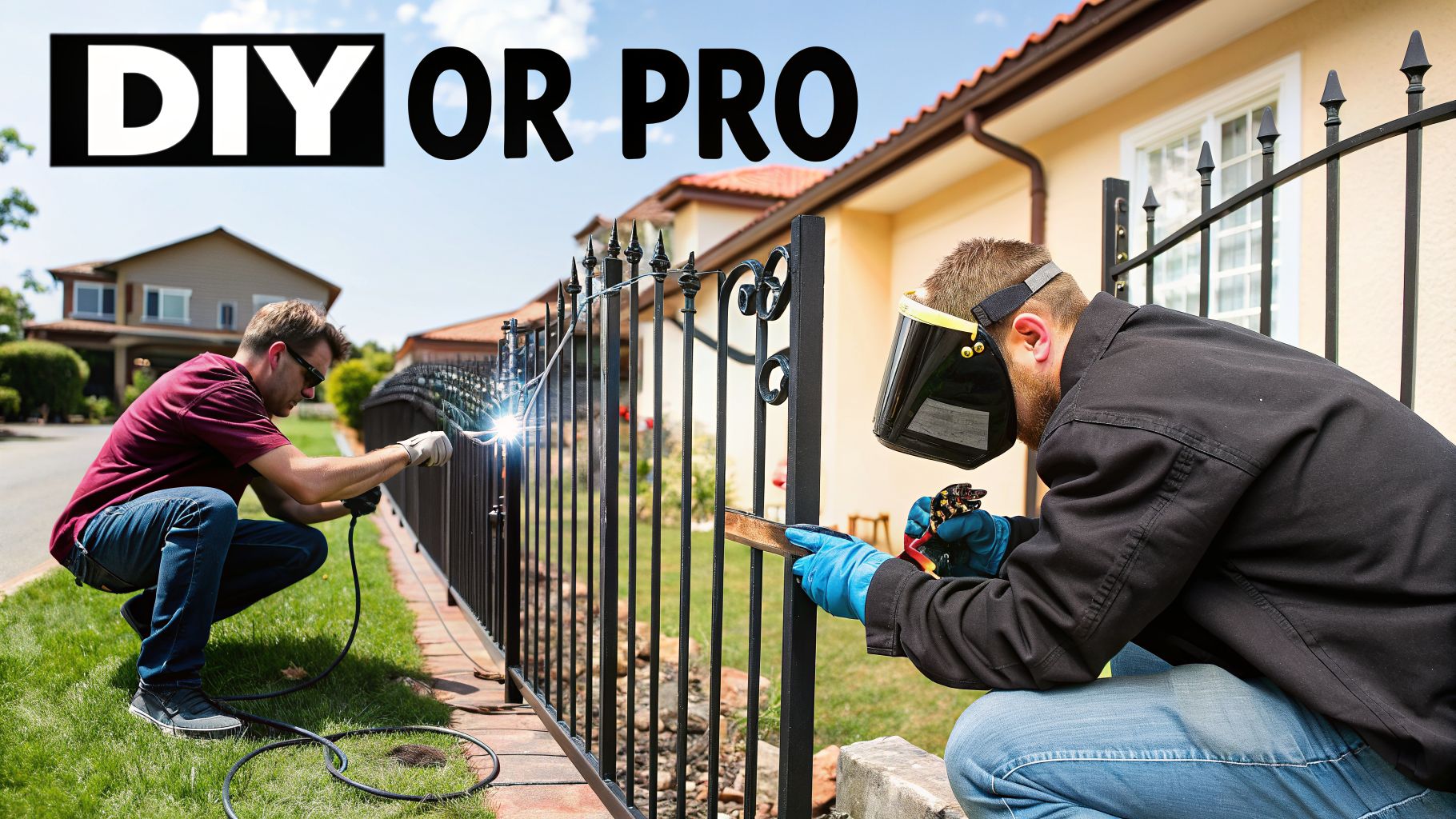
When you spot a problem with your iron fence, the first question is almost always, "Can I fix this myself?" It's a great question. Knowing when to roll up your sleeves for a weekend project versus calling in a professional for iron fence repairs is key. Making the right call can save you a ton of time, money, and future headaches.
Some fixes are absolutely perfect for a handy homeowner. Think of small, cosmetic issues—they make for a satisfying weekend project. With a little patience and the right materials, you can get fantastic results and add years to your fence's life.
When DIY Is a Smart Choice
Think of minor fence work like patching a small nail hole in the wall. It’s completely manageable if you do your prep work and have the right supplies from the local hardware store. A do-it-yourself approach can be very effective for these smaller-scale issues.
These are the kinds of tasks that are generally safe to tackle on your own:
- Treating Minor Surface Rust: If you catch rust early—when it's just a faint orange powder on the surface—you can definitely handle it. It's a matter of sanding or wire-brushing the spot down to bare metal, applying a rust-inhibiting primer, and then touching it up with a matching paint.
- Touching Up Chipped Paint: Small scratches and paint chips are easy fixes, but they're critical for stopping rust before it starts. The trick is all in the prep work; clean the area well before you prime and paint.
- Tightening Loose Hardware: Gate hinges and latches can work themselves loose over the seasons. Often, all you need is a simple wrench or screwdriver to tighten things up and get that gate swinging smoothly again.
The absolute golden rule for successful DIY repair is being thorough. The most common mistake is rushed prep work. If you just paint over rust without removing it all the way, it will bubble right back through within a few months, and you'll be doing the job all over again.
Knowing When to Call a Professional
Now, let's be honest. Some jobs go way beyond basic upkeep and get into serious structural work. The comparison changes completely. Trying to weld a broken rail isn't like patching a wall; it's more like trying to rewire your home's breaker box. Without proper training, specialized equipment, and a deep understanding of safety, you're more likely to make the problem worse or even get hurt.
A poorly done weld, for instance, can easily be weaker than the original break, turning a simple repair into a real safety hazard.
To help you decide, here’s a quick guide comparing DIY and professional approaches for common fence problems.
DIY vs. Professional Repair Decision Guide
| Repair Task | DIY Feasibility | Required Tools & Skills | When to Call a Pro |
|---|---|---|---|
| Minor Surface Rust | High | Sandpaper, wire brush, rust-inhibiting primer, matching paint. Basic patience. | If rust covers more than 10-15% of a section or has started to pit the metal. |
| Chipped Paint | High | Cleaning supplies, sandpaper, primer, and touch-up paint. | If the paint is peeling or failing on a large scale, requiring a full repaint. |
| Loose Gate Hinge | High | Wrench set or screwdrivers. Basic mechanical skill. | If tightening the hardware doesn't fix a sagging gate; this means the post is the issue. |
| Broken Picket or Rail | Low | Requires a welder, grinder, and metal fabrication skills. Very high risk. | Always. Welding is not a DIY task without professional training and equipment. |
| Leaning Post | Low | Shovels, concrete, level, and a lot of muscle. Requires precision. | Always. Resetting a post footing is heavy labor and must be done correctly to last. |
| Major Rust Damage | Low | Professional grinders, sandblasters, and chemical treatments are needed. | When rust is flaking, scaling, or has eaten holes (pitting) into the iron. |
Ultimately, calling a professional is about buying peace of mind and a permanent solution. An expert not only has the right tools but also the experience to spot the real source of the problem. They won't just adjust a sagging gate; they'll diagnose the leaning post that's causing it and fix the footing for good.
Figuring Out Your Iron Fence Repair Budget in Connecticut
The first question homeowners in Connecticut always ask is, "How much is this going to cost?" It’s the most important question, and setting a realistic budget from the start prevents any unwelcome surprises when the estimate comes in.
Think of it this way: fence repair isn’t a one-price-fits-all service. A small rust spot that just needs a quick touch-up is like getting your car's oil changed—predictable and straightforward. But if a post is leaning or a railing has snapped, that’s more like major engine work. It requires a proper diagnosis to figure out the true cost of getting it right.
Key Factors That Drive Repair Costs
When a contractor comes out to look at your fence, they’re not just glancing at the problem. They’re evaluating a few key things that will ultimately shape the price on your quote. The more complex the problem, the more the cost will reflect the skill and time needed to fix it properly.
Here are the three main drivers that determine the final price:
- Extent of Damage: Are we talking about a single bent picket, or is an entire section of your fence showing its age with widespread rust and peeling paint? The sheer amount of work is the biggest factor.
- Repair Method: The technique needed to fix the problem plays a huge role. Sanding and painting a small patch is a relatively simple job. On the other hand, complex welding on a broken scroll or digging out an old concrete footing to reset a post are much more labor-intensive tasks.
- Accessibility: Can a repair truck pull right up to the fence line? Or is the damaged section on a steep hill, tucked behind mature landscaping? If the crew has to work around obstacles, that extra time and effort will be factored into the price.
This focus on maintaining existing property isn't just something we see in our own backyards. As towns and cities expand, keeping fences and other structures in good shape becomes a global priority. In fact, the rapidly urbanizing Asia-Pacific region accounted for 33.8% of the world's fencing market revenue in 2023. This is part of a massive industry, and you can see just how much it's growing—with a projected 6.92% growth rate—in a [detailed report on the global fencing market](https://www.fortunebusinessinsights.com/fencing-market-102 fencing-market-102559).
Ballpark Costs for Common Repairs
While every project has its own unique details, it helps to have a rough idea of what to expect. These numbers are a realistic starting point for common iron fence repairs here in Connecticut. Just remember, these are ballpark figures—you’ll always need a formal quote for an exact price.
A good estimate is more than a number; it's a game plan. It should clearly break down the work, the materials, and the labor, so you know exactly where your money is going.
Here are some typical cost ranges you can use for planning:
| Common Repair Job | Estimated Cost Range (Connecticut) | Notes |
|---|---|---|
| Rust Treatment & Repainting | $25 – $50 per linear foot | Price varies based on how severe the rust is and the prep work required. |
| Picket or Rail Welding | $150 – $400 per weld | This covers a single break, like a snapped picket or a crack in a rail. |
| Gate Hinge & Latch Repair | $125 – $300 | Includes adjusting, tightening, or replacing standard gate hardware. |
| Leaning Post Reset | $250 – $550 per post | This involves digging out the old footing, straightening the post, and pouring new concrete. |
Having these numbers in mind helps take the mystery out of the process. When you understand what goes into the cost, you can set a practical budget and move forward with your repair project confidently.
How to Hire the Right Fence Repair Contractor

When it comes to iron fence repairs, choosing the right contractor is everything. A real expert will provide a repair that lasts for years, blending seamlessly with your existing fence. On the other hand, a general handyman could make things worse, leaving you with a bigger bill and more headaches down the road. Knowing how to properly research a company is the best way to protect your investment and get the job done right the first time.
Iron and steel fences have always been a staple for security and classic good looks, but even the toughest materials need attention. The global demand for fence repairs is growing, especially in North America, which accounted for a massive 40% of the steel and wrought iron fence market revenue in 2024. Our region’s weather extremes are a big reason why—the constant cycle of freezing, thawing, and moisture puts these structures to the test, making quality repairs essential.
Your Vetting Checklist: Essential Questions to Ask
Before you even start comparing prices, you need to make sure you’re dealing with a legitimate, qualified professional. Any reputable contractor will be happy to answer these questions.
- Are you licensed and insured in Connecticut? This is the absolute first thing you should ask. It’s non-negotiable. A license shows they meet state standards, while proper insurance protects you and your property if an accident happens.
- Do you specialize in ornamental iron repairs? Putting up a new fence is one thing, but restoring iron is a different craft entirely. It requires expertise in welding, treating rust, and matching original designs. Ask to see photos of their past repair projects.
- Can you provide a detailed, itemized quote? A professional estimate breaks down all the costs for labor and materials, so you know exactly what you’re paying for. A vague verbal quote is a huge red flag.
- Do you offer a warranty on your work? A contractor who is confident in their skills will stand behind their repairs with a warranty. This gives you peace of mind knowing the fix is meant to last.
A contractor’s process is just as important as their final product. A clear, professional, and customer-focused approach from the first call to the final walkthrough is a strong indicator of quality workmanship.
Interestingly, you can often get a sense of a company's professionalism by how they present themselves online. Companies that invest in sound lead generation strategies for contractors are typically more established and customer-focused.
What the Professional Process Looks Like
Once you’ve found a few contractors who tick all the boxes on your checklist, pay close attention to their process. A true professional will guide you through each step, making sure you feel confident and informed. You can get a feel for what this involves by checking out our own approach to dedicated fence repair services.
Here’s a breakdown of what you should expect from a top-tier company:
- On-Site Consultation: The process should start with a visit to your property for a thorough inspection. A pro won't give you a blind quote over the phone. They’ll want to see the damage firsthand, listen to your concerns, and assess the full scope of the job.
- Detailed Written Proposal: After the visit, you should receive a formal proposal, not just a simple invoice. This document should clearly outline the work to be done, the specific materials they'll use, the total cost, and an estimated timeline for completion.
- Final Walkthrough and Approval: Once the repairs are finished, the contractor should walk the fence line with you. This is your opportunity to inspect the work up close, ask any final questions, and make sure every detail meets your expectations before signing off.
A Few Final Questions About Iron Fence Repairs
Even after walking through the process, you probably have a few specific questions on your mind. That’s perfectly normal. Here are the answers to some of the most common things we get asked by homeowners and property managers across Connecticut.
Can My Rusted Iron Fence Be Saved, or Does It Need to Be Replaced?
I get this question all the time, and the answer almost always brings a sigh of relief: in most cases, a rusted iron fence can absolutely be saved. The real issue isn't whether there's rust, but how deep that rust has gone.
Surface rust, that orange, powdery stuff you can see, is almost always just a cosmetic problem. Even when it starts to flake and peel, a skilled professional can typically grind it away, treat the underlying metal, and get it looking new again.
The real point of no return is when rust has eaten completely through the iron, creating holes or making sections brittle and weak. We call this ‘structural rust,’ and it means the fence's strength and safety are compromised.
This is where a professional eye is crucial. If the core structure of your fence is still solid, a proper repair will give you many more years of service and is far more cost-effective than starting from scratch.
How Often Should I Inspect My Iron Fence for Damage?
A little proactive inspection goes a long way in preventing big, expensive problems. A good rule of thumb is to give your fence a close look twice a year—once in the spring and again in the fall. It's also smart to do a quick walk-around after any major storm.
Here’s a simple checklist for these seasonal check-ins:
- Spring Inspection: Once the winter snow and ice have melted, check for damage from the thaw, snowplows, or salt spray. Pay special attention to the base of the posts where moisture sits and check all the welds for stress.
- Fall Inspection: Before the cold weather sets in, look for any paint chips or new rust spots. Taking care of these with a quick touch-up prevents moisture from getting trapped under the paint and causing major headaches over the winter.
Catching these issues early means you can often fix them yourself in a few minutes, avoiding a much bigger bill for iron fence repairs later on.
What's the Right Kind of Paint for an Iron Fence?
This is where so many DIY repairs go wrong. Please, step away from the all-purpose spray paint at the big-box store! For a repair that actually lasts, you need to use a direct-to-metal (DTM) industrial enamel.
These paints are designed specifically to bond to metal and are packed with rust-inhibiting compounds that actively fight corrosion. But the paint itself is only half the battle. A professional paint job is a three-step process, and skipping a step is just asking for rust to return.
- Flawless Prep: The surface has to be perfectly clean. All rust, all dirt, and all old, peeling paint must be completely removed.
- The Right Primer: A rust-inhibiting metal primer is applied to seal the raw metal from air and moisture and give the topcoat something to grip onto.
- Durable Topcoats: At least two full coats of DTM paint are needed to build up a tough, protective shell that can stand up to Connecticut weather.
A standard hardware store paint might look fine for a season, but it offers almost no real protection. You’ll be right back out there, scraper in hand, doing the job all over again next year.
Is Fixing a Sagging Iron Fence Gate Expensive?
A sagging gate is an annoying problem, but here's the good news: it's usually a straightforward and relatively inexpensive fix, especially if you catch it early. The cause is almost always one of two things: the hinges or the post.
Sometimes, the hinges simply work themselves loose over the years, or the screws get stripped. In those cases, tightening, reinforcing, or replacing the hardware is a quick job for a pro.
More often, though, the gate post itself is leaning. Connecticut’s freeze-thaw cycles are notorious for shifting the ground and weakening the concrete footing that holds the post steady. A professional can typically dig out, straighten the post, and pour a new, stronger footing without replacing the whole post. It's a much less involved repair than other structural work and makes a world of difference.
We hope this guide has given you the confidence and knowledge to tackle your fence project. For expert advice and professional iron fence repairs in Connecticut, trust the team at Connecticut Fence Works, LLC. We combine superior workmanship with clear communication to deliver lasting results. Get your free estimate today.