
A Pro Guide to Fence Installation in Winter
It's a common question we get every fall: "Should I wait until spring to put up my fence?" The answer might surprise you. Yes, you can absolutely install a fence in the winter, and honestly, it’s a smart move many homeowners are making. A fence installation in winter can mean a faster timeline and far less disruption to your yard, getting your property secure and ready for spring before the busy season even starts.
Why Winter Might Be the Best Time for a New Fence in Connecticut
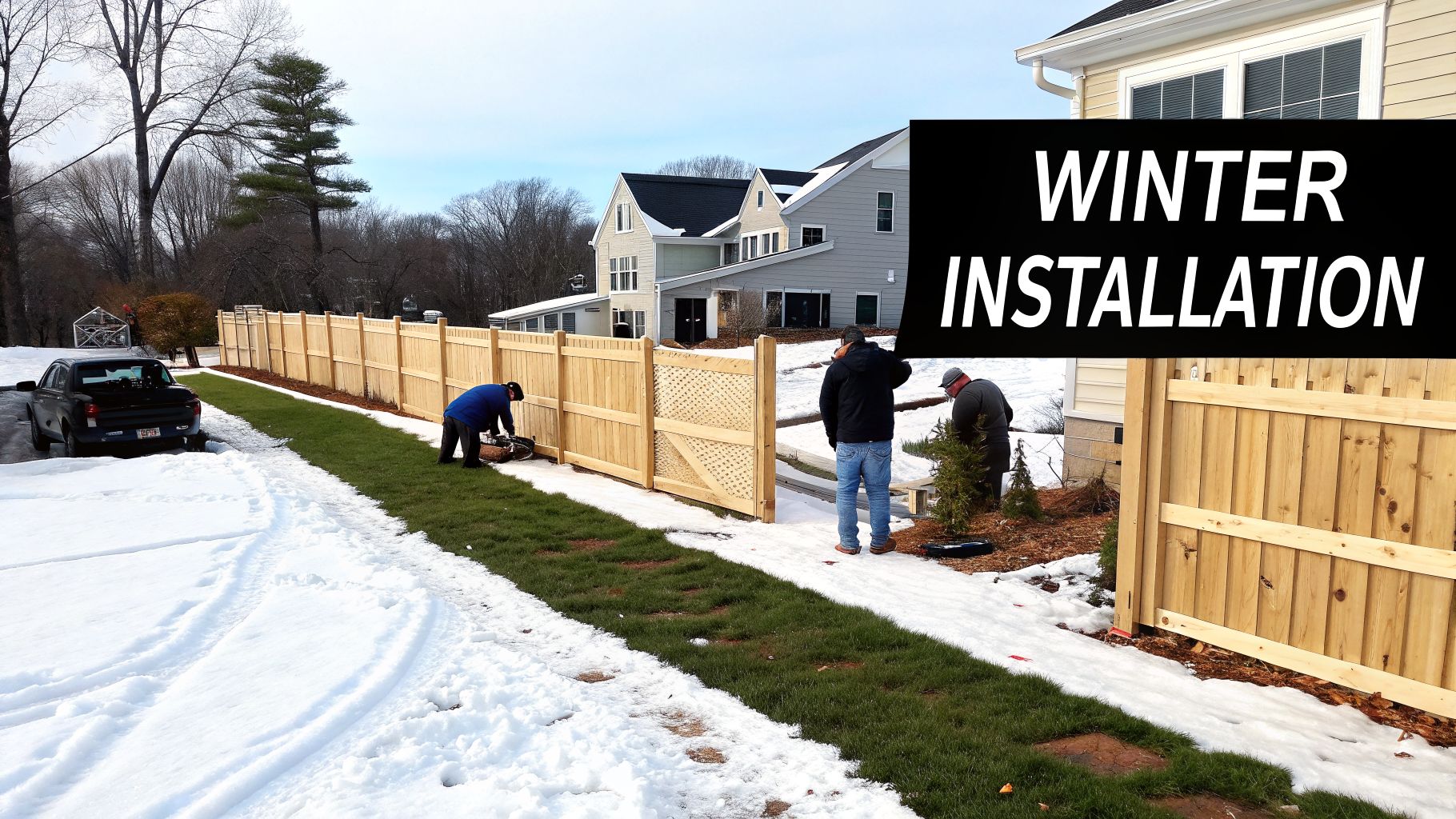
Starting a major outdoor project during a Connecticut winter seems like a bad idea at first glance. Between the cold, the snow, and the frozen ground, most people assume they have no choice but to wait. But based on our years of experience, this assumption can cause you to miss out on some real advantages.
With the right equipment and an experienced crew, a fence installation in winter isn't just possible—it's often a much smoother process. Here at Connecticut Fence Works, we are equipped for cold-weather work. It all comes down to knowing how to handle the unique challenges, from breaking through frozen soil to ensuring concrete sets correctly in low temperatures.
Beat the Spring Rush
One of the biggest frustrations of a spring fence project is the wait. As soon as the weather improves in March and April, our phones start ringing constantly. That sudden surge in demand creates a bottleneck, leading to long waits for consultations, estimates, and the installation itself.
We’ve seen a major shift in recent years. More people are scheduling winter installations, and they're seeing 40% shorter wait times than those who wait for spring. Across the Northeast, where winters can bring 20-30 inches of snow, the demand for fencing can drop by nearly 70% from the summer peak. This means we can often get a project started in just 1-2 weeks, which is much faster than the typical 6-8 week backlog in April and May.
By scheduling your project in the off-season, you get your fence on the calendar and completed fast. Your new fence will be standing and ready for you to enjoy the second the weather turns, instead of spending those first beautiful spring days just waiting for an installer to show up.
Protect Your Landscaping
Here’s something most homeowners don't consider: a spring or summer installation can be tough on your yard. With everything in full bloom, heavy foot traffic and equipment can easily trample gardens, damage lawns, and leave ruts that need fixing.
In winter, your landscape is inactive and protected. The frozen ground is hard and sturdy, acting as a solid foundation that resists damage. A layer of snow provides even more of a buffer. The result is a clean installation with almost no impact on your property. When the spring thaw arrives, your yard comes back to life with your new fence already standing guard—no construction marks in sight.
Think about it this way:
- Dormant Plants: Your grass, shrubs, and flowers are "asleep" and far less likely to be harmed.
- Solid Ground: Frozen soil is firm, which prevents equipment from sinking and creating deep tracks in your lawn.
- A Clean Slate: Any minor scuffs on the inactive ground will vanish as soon as new growth starts in the spring.
Winter Fence Installation At a Glance
Still weighing the pros and cons? This quick-reference table breaks down the key differences between scheduling your fence installation in the winter versus waiting for the peak season.
| Key Aspect | Winter Installation (Pro) | Spring/Summer Installation (Con) |
|---|---|---|
| Scheduling | Faster project start times, often within 1-2 weeks. | Long wait times, typically 6-8 weeks or more. |
| Yard Impact | Minimal disruption to inactive lawns and gardens. | High potential for damage to active landscaping. |
| Project Timing | Fence is ready for immediate use in the spring. | Installation may consume valuable spring/summer weeks. |
| Contractor Focus | More personalized attention from less-rushed crews. | Crews are often managing multiple, overlapping projects. |
As you can see, the off-season offers some compelling benefits that go beyond just getting a fence up. It allows for a more focused and efficient project from start to finish.
How Cold Weather Impacts Fencing Materials and Installation
Any professional will tell you that a successful winter fence installation comes down to one thing: respecting the cold. You can't fight the laws of nature. Cold temperatures change the way everything behaves, from the fence panels themselves to the very ground we're working on. Our job is to anticipate those changes and use the right techniques to guarantee your fence is strong, straight, and ready for a lifetime of New England seasons.
If you ignore these factors, you are just asking for trouble later. Materials that haven't been properly adjusted to the temperature can warp or crack, and posts set in frozen ground without the right expertise will eventually shift. Let's walk through how we handle these challenges and turn them into non-issues.
The Behavior of Fencing Materials in the Cold
Every material we work with reacts to a temperature drop in its own way. An experienced crew knows these characteristics and adjusts accordingly. This isn't just about getting the fence up; it's about making sure it looks great and stays put for decades.
Here’s a quick look at what we’re dealing with when it comes to popular materials:
- Vinyl (PVC): When it gets cold, vinyl becomes more brittle and less flexible. A simple drop or a misplaced hammer tap that would be fine in July can cause a crack in January. We handle these panels with extra care, avoiding any sudden impacts.
- Wood: Winter air is cold and dry, which makes wood shrink. We account for this natural shrinkage when we set our posts and fasten the boards, leaving precise gaps. This allows the wood to expand again during the hot, humid summer months without buckling or warping.
- Aluminum & Metal: Even durable metals shrink slightly in the cold. We’re careful to use the right fasteners and bracket settings that allow for this subtle movement, which prevents unnecessary stress on the connections over time.
We never start an installation the moment materials arrive. They need to sit on-site for at least 24 hours to get used to the outside temperature. This simple, required step prevents the sudden temperature change that can cause materials to fail down the road.
Tackling Frozen Ground and Frost Heave
The number one question we get is, "How can you possibly dig in frozen ground?" The short answer is: not with a shovel.
We bring in heavy equipment. Our crews use powerful, gas-powered augers fitted with carbide-tipped blades that are specifically designed to cut through frozen earth. These tools create clean, perfect holes for the posts without shattering the surrounding soil, which is critical for creating a stable foundation.
But digging is only half the battle. The real enemy in winter is frost heave. This is what happens when moisture in the soil freezes and expands, pushing the ground upward. If your fence posts aren't set deep enough, frost heave will slowly push them out of the ground year after year, leaving you with a wavy, crooked fence.
To stop this from ever happening, we always dig our post holes below the local frost line. Here in Connecticut, that's typically 36 to 48 inches deep. By setting the concrete base for the post in the stable, unfrozen soil below this line, we anchor it completely. It’s the only way to guarantee your fence stays perfectly level for years to come. Choosing a material that works well with our climate, like our popular vinyl fencing options, is also a key part of a long-lasting installation.
Winter Installation Preserves Your Landscape
From a practical standpoint, one of the biggest wins for a winter installation is how gentle it is on your yard. With your lawn, gardens, and flower beds inactive, they're far more resilient to the foot traffic and equipment that a fence project requires.
In fact, a winter install is the best way to protect your landscape. We’ve seen it time and again: damage to lawns and plantings is reduced by up to 80% compared to a spring or summer job. Think about it—with vegetation asleep, sometimes under a protective blanket of snow in places like New Haven or Tolland counties where winter lows average 20°F, there's zero risk to your prize-winning roses or freshly seeded grass. This is a huge difference from the 50-60% yard disruption many homeowners see with warmer weather projects, as noted in these insights on seasonal installation benefits.
This means that when spring finally arrives, your yard wakes up looking beautiful and untouched. Your brand-new fence is already there, with no ruts in the lawn, no trampled shrubs, and no reseeding to worry about. It’s simply the cleanest, most efficient way to get it done.
A Look at Our Winter Fence Installation Process
You might be wondering what a fence project actually looks like in the middle of winter. It’s a fair question. Rest assured, our process is just as careful and professional as it is in July—it just involves a few extra steps and some specialized equipment to handle the cold and frozen ground. We’ve fine-tuned our approach over the years to ensure everything goes smoothly, from the first site visit to the final cleanup.
It all starts with a detailed consultation right at your property. We’ll walk the proposed fence line with you, taking precise measurements and identifying any potential challenges like steep slopes, tricky corners, or existing landscaping. Even if there's a blanket of snow, this step is crucial for getting a feel for the land and planning a flawless installation.
Getting the Site Ready: Snow and Property Prep
Before we can even think about digging, we have to prepare the worksite. If there’s a lot of snow on the ground, our first task is to clear a wide path along the entire fence line. This gives us the access we need for our crew and equipment, and just as importantly, it lets us accurately mark out property lines and post locations.
A common worry we hear is about the mess from moving all that snow. We understand. Our crews are trained to work cleanly, piling snow in out-of-the-way spots and keeping your driveways and walkways clear. The goal is always to minimize disruption and treat your property with respect.
Once the path is cleared, we can get our materials and equipment in place without any problems. It’s a straightforward but vital part of setting the stage for a successful winter build.
Here’s a quick overview of the key phases involved in a professional cold-weather installation.
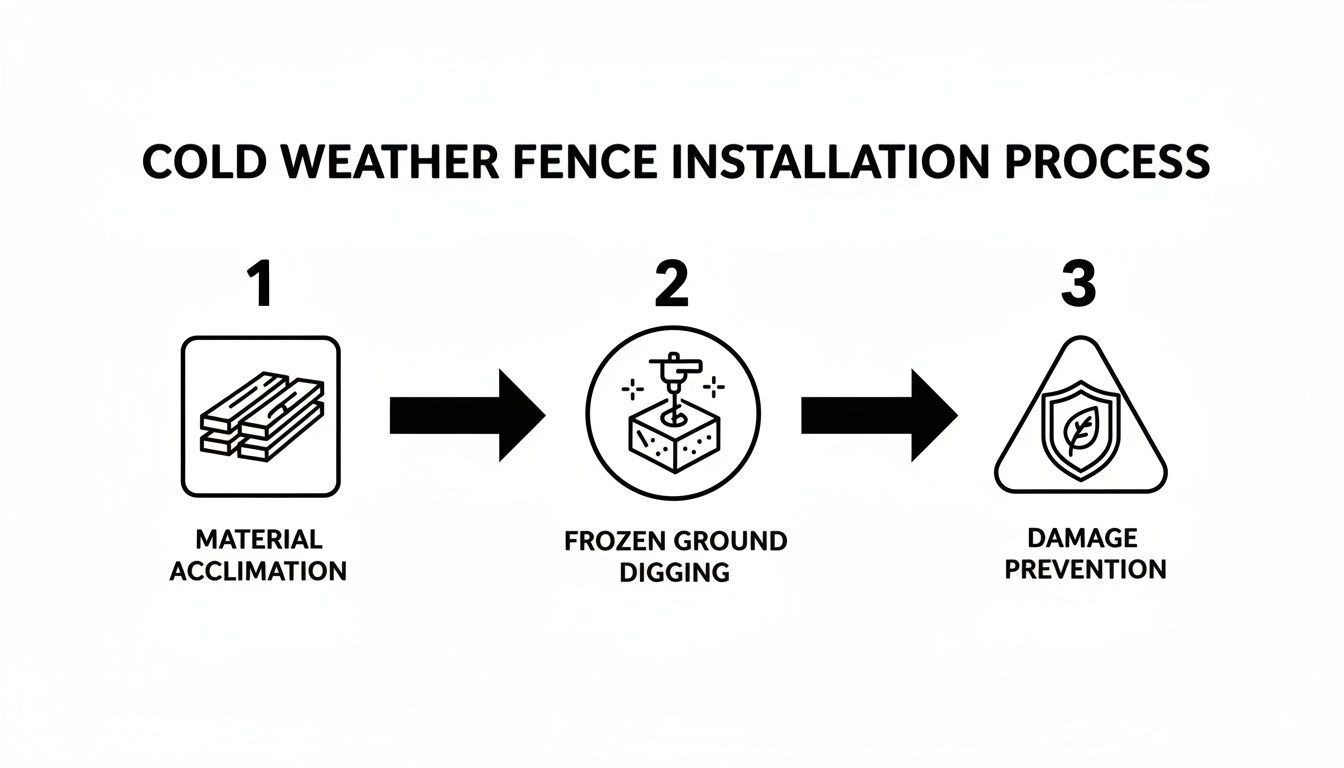
As you can see, it's a careful balance of using the right materials, specialized techniques for the conditions, and managing the site properly.
Setting Posts in Frozen Ground: The Most Critical Step
With the site prepped, it’s time to tackle the frozen earth. This is where experience and professional-grade equipment truly matter. Forget trying to break through frozen soil with a standard post-hole digger; we use powerful hydraulic augers equipped with aggressive, frost-fighting bits that cut right through it.
Every single post hole is dug well below the regional frost line—here in Connecticut, that means going down 36 to 48 inches. This isn't just a best practice; it's absolutely necessary. By setting the posts in the stable, unfrozen soil deep underground, we prevent "frost heave," the winter phenomenon that can slowly push improperly set posts right out of the ground and wreck an entire fence line.
We mix our concrete on-site using a heated, fast-setting blend designed for cold weather, ensuring it hardens correctly. Each post is then set perfectly straight and level, creating the unshakeable foundation your new fence needs to last for decades. If you're trying to decide on the right style, feel free to browse our residential fencing solutions for inspiration.
Finishing Touches: Attaching Panels and Gates
Once the concrete bases have fully hardened and the posts are rock-solid, our crew returns to finish the job. This part moves pretty quickly. We attach the panels or build the sections between the posts, always allowing for the slight expansion and contraction that materials undergo with temperature changes.
Gates require special attention. We hang and adjust each one carefully to ensure it swings smoothly and latches securely, making fine-tuned adjustments for a perfect, friction-free fit.
Our job isn't done until your property is spotless. We perform a thorough cleanup, removing all debris and materials, tidying up any disturbed areas, and leaving you with nothing but a beautiful, brand-new fence.
Understanding the Costs and Savings of a Winter Fence
Let's talk about the bottom line. Beyond the easier scheduling, the most powerful reason to plan your fence installation for the winter is the impact on your wallet. It all comes down to simple supply and demand, which tips squarely in your favor during the colder months.
When the rush for fencing dies down, both labor and materials often become more affordable. This isn't just about catching a sale; it's a strategic financial move. Reputable fence companies want to keep their skilled crews working year-round, not just during the sunny season. That need for steady work often means more attractive pricing for homeowners ready to build in December, January, or February.
The Economics of Off-Season Fencing
Come spring and summer, fencing contractors are usually booked solid for months out. That high demand naturally leads to higher pricing and long waits. But once the cold weather sets in, the whole picture changes. With fewer projects on the calendar, contractors have more flexibility and a real incentive to fill their schedules.
This is where you gain a serious advantage. One of the biggest perks of a winter fence installation in Connecticut is the potential for cost savings of 10-20% on your entire project. In a major market like the Northeast, where over 60% of fence work happens between May and August, the winter sees demand drop by as much as 50-70%. This slowdown prompts discounts to keep experienced crews busy, as detailed in these seasonal fencing trends and their financial impact.
It's a lot like booking a vacation. Everyone knows you pay top dollar to travel during peak season. The exact same principle applies here—scheduling your project when demand is low is the surest way to find significant savings.
A Real-World Savings Scenario
So what does this look like in practice? Let's take a common project: installing 150 linear feet of a standard 6-foot vinyl privacy fence for a typical suburban backyard in Connecticut.
- Peak Season (Spring/Summer) Estimate: A job like this might run you about $12,000, reflecting the high demand for both materials and labor.
- Off-Season (Winter) Estimate: By simply shifting that same project to the winter, you could see a 15% price reduction.
That small change in timing could easily save you $1,800. That’s real money you could put toward spring landscaping, an upgraded gate, or just keep in the bank.
This isn't just for vinyl, either. The savings apply across the board.
| Fence Project Type (150 ft) | Typical Peak Season Cost | Potential Winter Savings (10-20%) | Your Final Cost |
|---|---|---|---|
| Vinyl Privacy Fence | ~$12,000 | ~$1,200 – $2,400 | ~$9,600 – $10,800 |
| Cedar Wood Fence | ~$10,500 | ~$1,050 – $2,100 | ~$8,400 – $9,450 |
| Aluminum Ornamental Fence | ~$13,500 | ~$1,350 – $2,700 | ~$10,800 – $12,150 |
The numbers don't lie. You get the same high-quality fence from the same expert installers, but at a noticeably better price, just by being strategic about your timeline.
Don't Forget the Hidden Perks
The direct cost savings are fantastic, but they're not the only financial benefit. A winter installation often brings some less-obvious perks that can really add up.
A big one is a much smoother permitting process. Your local town and city building departments are usually swamped in the spring with applications for decks, pools, and home additions. That flood of paperwork can slow everything to a crawl.
Submitting your fence permit application in the quiet of winter often means a quicker review and faster approval. This avoids frustrating delays, gets your project started on time, and ensures you can lock in that great off-season pricing without a hitch.
Why You Need a Professional for Winter Fencing

We get it—the urge to tackle a home project yourself is strong. But when it comes to a fence installation in winter, this is one job where calling in an expert is not optional. The challenges of cold weather and frozen ground can quickly turn a weekend project into a costly disaster.
If you try to install a fence on your own in the dead of winter, you’re up against some serious risks. Without industrial-grade equipment, you simply won't get the post holes deep enough. The result? A fence that lifts, leans, and warps with the very first spring thaw. Cold temperatures also make materials like vinyl brittle, meaning one accidental bump could crack a whole panel and send you back to the store.
The Specialized Equipment Advantage
The biggest obstacle is obvious: the frozen ground. That post-hole digger you can rent from the local hardware store isn't going to make a dent. Professional crews, on the other hand, show up with powerful hydraulic augers and specialized frost-fighting bits designed to cut right through frozen soil.
This heavy-duty equipment is the only way to guarantee every hole is dug cleanly to the right depth—usually 36 to 48 inches here in Connecticut—to get well below the frost line. Honestly, this single step is what separates a stable, long-lasting fence from one that will fail in a year or two.
When you hire a professional, you're not just paying for labor. You're getting access to thousands of dollars in machinery that makes a proper winter installation possible in the first place.
Experience Handling Cold-Weather Challenges
Beyond just the digging, a seasoned crew brings years of firsthand knowledge of working in freezing temperatures. They know exactly how different materials behave in the cold and how to handle them to avoid damage. It's a skill you only learn from experience.
- Material Acclimation: A pro knows to let all fencing materials sit on-site for at least a day. This allows them to adjust to the outside temperature and prevents the sudden temperature change that can lead to cracks and warping.
- Concrete Curing: They don't just use any old concrete mix. We use specific formulas with warm water and additives that ensure the concrete hardens properly, even in low temperatures, creating a rock-solid base for every post.
- Precise Installation: An experienced installer anticipates the natural shrinking of wood and metal in the cold. They set fasteners and gaps with precision, allowing for the materials to expand naturally when summer arrives without buckling or breaking.
Professionals are also trained to manage the job site safely, conducting thorough risk assessments for construction to account for icy surfaces and other winter hazards. It’s a level of planning that’s often missed in a DIY attempt.
Reliability and Superior Workmanship
Since 2014, Connecticut Fence Works has built its reputation on rock-solid reliability and craftsmanship. Our installers aren't seasonal workers; they're career professionals who build fences all year long. That means we’ve perfected our process for executing a flawless fence installation in winter.
Working with us means your investment is protected. Our experience ensures every post is perfectly straight, every panel is secure, and your property is left in great shape. And if you ever do run into an issue, our expertise extends to professional fence repair services as well. Choosing an expert team is your guarantee that the fence won't just look fantastic on day one—it will stand strong for decades.
Common Questions About Winter Fence Installation
Even the most prepared homeowner has questions before breaking ground, especially when it comes to a winter project. Installing a fence in the colder months has its own unique set of challenges and advantages, so let's clear up some of the most common things we get asked.
We want you to feel completely confident in your decision. By tackling these concerns head-on, we hope to show you that with an experienced crew, a winter installation isn't just possible—it can actually be the smartest move you make for your property.
Can a Fence Be Installed in the Snow?
Yes, absolutely. Our crews are out there installing fences in the snow all winter long. The first thing we do is clear a wide path along the entire fence line. This gives us a clean workspace to take precise measurements and stake out the exact post locations.
A few inches of snow on the ground won't slow us down one bit. Of course, if a major blizzard is rolling through, we may need to push the start date for everyone's safety, but typical winter weather is just part of the job.
You can also rest assured that we treat your property with respect. Any snow we move is piled neatly out of the way, and we always keep your driveways and walkways clear.
Does the Cold Weather Affect the Quality of the Fence?
Not when it's done right. An experienced, year-round installer knows the specific techniques needed to guarantee your fence is just as strong and durable as one installed in July. A DIY-er might not know these tricks of the trade, but for us, they're standard procedure.
For instance, we let all our materials—especially vinyl and wood—adjust to the outdoor temperature on-site for at least 24 hours. This simple step prevents cracking or warping by letting the material get used to the cold before it's installed. We also use a special concrete mix with warm water that's designed to set fast and harden properly in low temperatures, creating a rock-solid foundation for every post.
Will My Yard Be Damaged During a Winter Installation?
Believe it or not, your yard is actually safer during a winter installation. In the spring and summer, the ground is soft, and your lawn and gardens are in a delicate growth phase. In winter, the conditions are much more favorable for construction.
- Frozen Ground: The firm, frozen soil is a perfect work surface. It resists ruts, soil compaction, and damage from our equipment and foot traffic.
- Dormant Landscape: Your lawn, shrubs, and flowers are inactive, making them far more resilient. A blanket of snow provides an extra layer of protection.
- A Clean Slate: Any minor scuffs on the inactive grass will disappear as soon as spring growth begins, leaving behind no evidence that we were ever there.
When you look at it this way, winter is easily the least disruptive season for your landscape.
Should I Wait to Stain My Wood Fence Until Spring?
Yes, we always recommend waiting for warmer weather to stain a new wood fence. Applying stain properly requires several consecutive days of mild, dry weather to allow it to soak into the wood and dry correctly. Those conditions are almost impossible to find during a Connecticut winter.
Our standard process is to build your beautiful new wood fence now, giving you the privacy and security you need through the winter. Then, we’ll schedule a time to come back in the late spring or early summer to professionally apply the stain. This two-step approach ensures your fence is built when you need it and finished when the weather is ideal for a perfect, long-lasting result.
Ready to beat the spring rush and have your new fence ready for the first warm day of the year? The experienced, year-round installers at Connecticut Fence Works, LLC are here to help. Get started with your free, no-obligation estimate today by visiting us at https://ctfenceworks.com.