
Stockade Fence Prices 2026: A Complete Guide to Costs & Installation
Let's get straight to the point: what does a new stockade fence actually cost? When you're budgeting for a professionally installed, standard 6-foot tall stockade fence in Connecticut, you should plan for a range of $25 to $45 per linear foot.
For a typical 150-foot backyard project, that translates to a total investment somewhere between $3,750 and $6,750. This all-in price gives you a solid starting point for planning your project.
Connecticut Stockade Fence Prices At A Glance
To understand what you're paying for, it helps to think of the total cost as two main parts: the materials for the fence itself and the skilled labor needed to install it correctly.
The stockade fence has long been a homeowner favorite, and for good reason. It provides excellent privacy and security at a price that's hard to beat. The design is simple but effective—vertical boards placed tightly together to create a solid visual barrier, perfect for keeping your backyard private and your pets safe.
Breaking Down the Costs
That price-per-linear-foot figure is a great benchmark, but what does it actually cover? A professional quote from a reputable company bundles everything you need into that one number.
To give you a clearer picture, here’s a table breaking down the typical costs for a professionally installed 6-foot stockade fence in Connecticut.
Estimated Stockade Fence Costs in Connecticut (2026)
| Cost Component | Average Price Range (Per Linear Foot) | Notes |
|---|---|---|
| Materials | $10 – $20 | Includes the wood panels or pickets, support posts, and rails. The type of wood—pressure-treated pine versus a more expensive cedar, for example—is the biggest factor here. |
| Professional Labor | $15 – $25 | This covers the experienced crew's time for site preparation, digging post holes, setting posts in concrete, assembling the fence, and complete cleanup. |
| Total Installed Cost | $25 – $45 | This is your all-in, complete figure from a professional contractor. It represents the entire project from start to finish. |
As you can see, labor is a large part of the cost. This is why a properly installed fence is an investment in a long-lasting, durable product.
The Market for Wood Fencing
The lasting popularity of stockade fencing is a huge factor in the North American wood fencing market, an industry valued at $2.63 billion in 2023. Experts project it will climb to $3.28 billion by 2032, proving its long-term appeal.
On a national level, the affordability of pressure-treated pine keeps the per-foot costs between $13.70 and $19.01. For a smaller 79-foot project, this would total around $1,801–$3,331, including about 12.5 hours of labor. You can dive into a detailed analysis of these national cost figures to see how they compare to our local Connecticut pricing.
The Expert Takeaway: Remember, the "per linear foot" cost is a comprehensive number. It’s not just the wood panels; it’s the posts, the concrete, and the expert labor required for a sturdy fence that will stand up to Connecticut's seasons for years. While a DIY approach might look cheaper on paper, professional installation ensures it's done right the first time.
What Really Drives Your Final Fence Cost
That average price-per-foot figure is a great starting point, but the final number on your estimate depends on many small decisions and the unique layout of your property. It's like buying a new truck; the base price looks good, but the final cost changes once you add optional features like a tow package or a bigger engine.
Your first major decision, and the one that will have the biggest impact on your budget, is the wood you choose. For stockade fences, it almost always comes down to pressure-treated pine versus cedar. Pine is the budget-friendly choice, while cedar has a higher price but offers significant natural advantages.
This is the classic trade-off between upfront cost and long-term value. Choosing cedar over pine can increase your material costs by 20-30%. For that investment, you get a wood that naturally resists rot and insects. In a place like Connecticut, with our humid summers and freeze-thaw winters, this is a smart choice that can save you money on maintenance in the long run.
The Building Blocks of Your Fence Price
Beyond the type of wood, a few other key choices will directly shape the final cost. Each one adds up, so it helps to know what to expect.
Here are the main components that we factor into every stockade fence project:
- Fence Height: A standard 6-foot privacy fence simply requires more wood and sturdier posts than a 4-foot version. Taller fences often need their posts set deeper for stability, which also adds a bit more labor to the job.
- Wood Type and Quality: We’ve already covered the pine vs. cedar debate. But even within those categories, different grades of wood—determined by factors like the number of knots—come at different prices.
- Post Spacing: How far apart should your posts be? Setting them every 6 feet instead of the standard 8 feet makes for a much stronger, more rigid fence. However, it does mean you'll need more posts and more labor to dig and set them.
Thinking through these elements helps you select the right fence for your needs. If you’re aiming for maximum durability, for instance, investing in cedar and closer post spacing is a choice you won't regret. You can learn more about what makes this wood special by exploring the benefits of cedar fencing.
On-Site Factors People Often Forget
Some of the most common budget surprises have nothing to do with the fence itself, but with the land it’s being built on. These are the property-specific variables that we, as installers, must consider. Overlooking them is how homeowners can get caught off guard by unexpected costs.
The price of lumber itself is a huge external factor. We've seen wood costs change dramatically over the years, and that directly affects project budgets. Stockade fences, built from timeless materials like pressure-treated pine or cedar, are also impacted. Data from the Producer Price Index for Sawn Wood Fence Stock shows a staggering 120% increase between 2003 and 2025. That doubling of material costs in two decades certainly influences your final estimate.
Beyond the lumber market, here's what we look for when we walk your property:
- Site Preparation: Is your yard flat and open, or does it have slopes? Building a fence on uneven ground takes more skill and labor to keep the line straight and minimize gaps at the bottom.
- Obstacle and Soil Removal: We're in the "Nutmeg State," but we could just as easily be the "Rock State." If we encounter heavy clay, large rocks, or thick tree roots while digging post holes, it takes more time and sometimes specialized equipment to get the job done right.
- Old Fence Removal: Do you have an old fence that needs to be removed? We can certainly handle taking it down and hauling it away, but that service adds to the labor and disposal costs.
- Gates and Hardware: A gate isn't just a swinging section of fence. It is a more complex structure that must be perfectly square and hung correctly. The final cost depends on the gate's width, its style, and the quality of the hardware—the latches and hinges—you choose.
- Permits: Depending on your town's rules and your fence's height, you might need a building permit. We can help you with this process, but the town's permit fee is a cost to include in your total budget.
Breaking Down a Real Stockade Fence Estimate
A professional fence estimate shouldn't be a mystery. To show you exactly what to expect from a transparent, detailed quote, we're going to walk through a few sample estimates for common projects we handle here in Connecticut. Seeing a real breakdown helps you understand the process and spot the difference between a thorough plan and a vague, one-line price.
This visualization highlights three of the biggest factors that will shape your project's total cost.
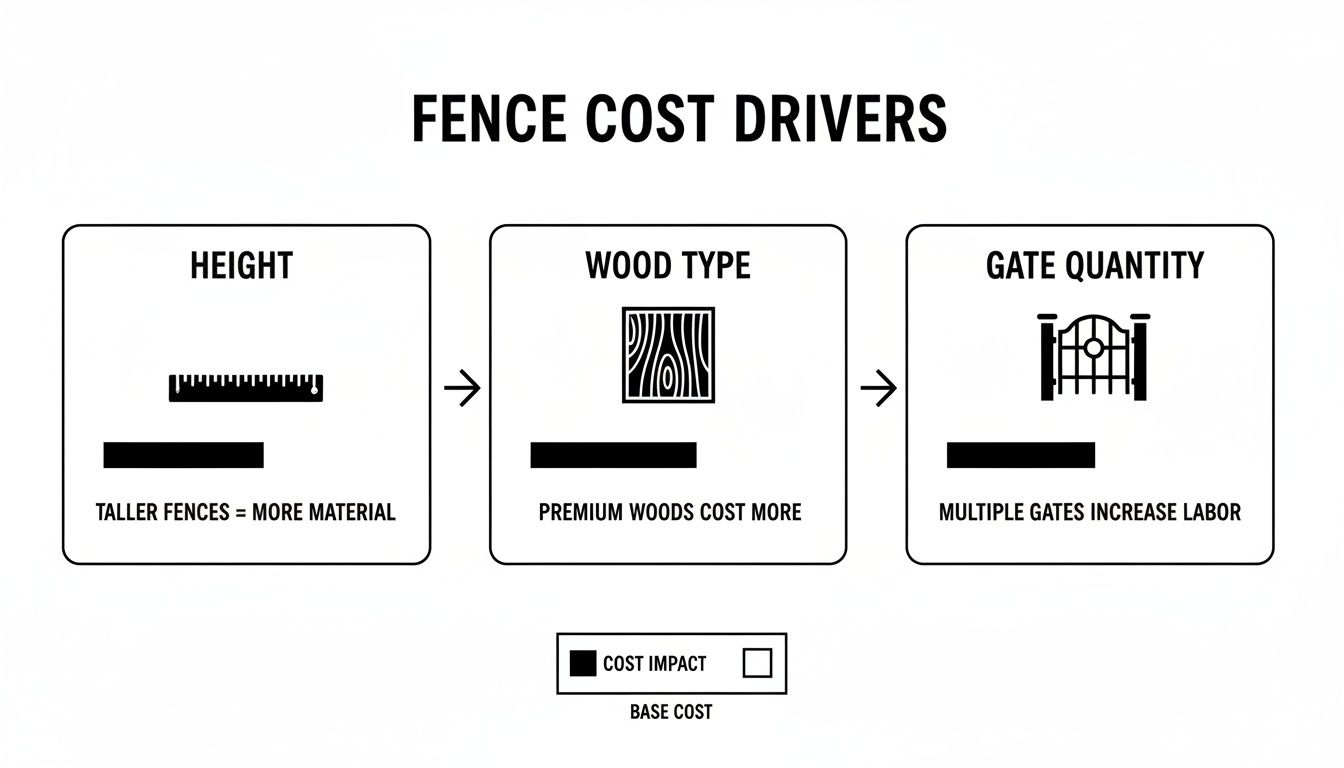
As you can see, the fence's height, the type of wood you choose, and the number of gates you need are the primary drivers of your final stockade fence price.
The core of any good estimate is honesty. You deserve to see exactly where your money is going. Vague quotes that only give you a single project total can be a red flag, often hiding shortcuts or setting you up for unexpected charges later on.
Sample Estimate 1: Hartford County Backyard Privacy
Let’s start with a classic scenario: a 150-foot privacy fence for a suburban backyard in Hartford County. The homeowner wants a standard 6-foot tall pressure-treated pine stockade to create a safe, enclosed space for their kids and dogs. We’ll assume the property is mostly flat with normal soil conditions.
A professional, itemized estimate for this project would look something like this:
- Materials ($1,800 – $2,250): This covers 150 linear feet of 6-foot pressure-treated pine fence panels, about 20 posts for standard 8-foot spacing, and all the concrete needed to set each post securely.
- Labor ($2,250 – $3,000): This is the cost for our experienced crew to handle all the on-site work. It includes mapping the layout, digging post holes, setting every post in concrete, assembling the fence sections, and a thorough site cleanup when we're done.
- Gate Installation ($450 – $600): For a standard 4-foot wide walk gate, this includes the gate panel itself, heavy-duty hardware (hinges and latch), and the extra labor to ensure it hangs perfectly and swings smoothly.
- Total Estimated Cost: $4,500 – $5,850
This breakdown clearly separates the materials from the skilled work required, giving you a complete and honest financial picture.
Sample Estimate 2: Tolland County Pet Enclosure
Now, let's look at a smaller project—a 75-foot fence with one gate to create a dedicated dog run at a Tolland County home. Because of the shorter length, the cost-per-foot might be slightly higher. This is because fixed costs like travel time and crew setup are spread across fewer feet of fence.
Here’s what that estimate would break down to:
- Materials ($900 – $1,125): This includes 75 linear feet of 6-foot pine panels, roughly 10 posts, and the necessary concrete.
- Labor ($1,200 – $1,500): This covers our crew's time for the complete installation, from digging the first hole to cleaning up at the end.
- Gate Installation ($450 – $600): Just like our first example, this accounts for one high-quality, properly installed walk gate.
- Total Estimated Cost: $2,550 – $3,225
Here's the Bottom Line: A quality estimate always breaks down costs into clear, logical categories. If you get a quote that just says "75-foot fence: $3,000," you have every right to ask for more detail. A contractor who stands by their work will be happy to explain exactly what that number includes.
Discussions in local forums for areas across Connecticut often support these numbers. For a standard 6-foot tall setup, a fully installed price usually lands between $20 and $25 per linear foot. Materials alone can account for nearly $15 of that. A typical 100-foot project often ranges from $1,800 to $3,300 total, which includes materials, labor, and tools but not taxes or extra prep for rocky ground common in places like Berlin, CT. You can get more firsthand accounts from homeowners by checking out the full discussion on fence pricing.
DIY Vs. Professional Installation: The True Cost Difference
It's tempting to look at a professional fence estimate, see the labor cost, and think, "I could save a lot by doing that myself." On paper, the DIY route seems like a clear winner for your wallet. But having been in this business for years, we can tell you the real math isn't that simple.
The true cost difference isn't just about subtracting our labor fee; it's about adding up all the hidden costs, unexpected challenges, and the value of your own time. When you hire a professional crew, you're not just paying for a few people to dig holes. You're paying for a seamless, warrantied result delivered with specialized equipment and years of experience.
The Overlooked Costs of DIY Fencing
The price tags on fence panels and bags of concrete at the hardware store are just the beginning. A realistic DIY budget has to account for all the extras that are typically included in a professional quote. Forgetting these can quickly turn your "savings" into a budget problem.
Here are the common costs that catch first-time DIYers by surprise:
- Heavy Equipment Rental: Connecticut’s soil is famously rocky. Trying to dig dozens of post holes three feet deep with a manual digger is a back-breaking, often impossible task. You'll likely need to rent a gas-powered auger, which can run $100-$150 per day, and you'll need a truck or trailer to transport it.
- Material Delivery: Fence panels, 8-foot posts, and hundreds of pounds of concrete will not fit in a family car. Unless you have access to a heavy-duty truck, expect to pay $100 or more for delivery.
- Waste Disposal: All that displaced dirt from the post holes has to go somewhere. If you're tearing out an old fence, you'll have that to deal with, too. Renting a small dumpster or paying for dump fees can add another unexpected expense.
- Tools and Supplies: It's never just the big tools. The cost of string lines, a good level, quality screws, saw blades, and other small essentials adds up much faster than you’d think.
The Most Valuable Asset: Your Time
The biggest hidden cost in any DIY project is your time. A professional crew can complete a 150-foot stockade fence in a day or two. For someone learning as they go, that same project can easily take up every weekend for a month.
Consider this common scenario: A homeowner spends two full weekends digging holes and setting posts. Everything looks great until the next spring. After the first winter, they notice the entire fence is leaning. The cause? The posts weren't set deep enough below the frost line, and Connecticut's ground freeze pushed them up. Now they have a much bigger, more expensive problem: fixing a failing fence.
This is a classic—and costly—DIY mistake. A professional installer not only knows the precise depth required for posts in our local soil but also backs their work with a warranty. If a post moves or a gate starts to sag, making it right is our job, not yours.
While some people genuinely enjoy the challenge, others find that maintaining a flawed installation is a constant headache. For those who would rather have a worry-free solution from day one, it might be worth exploring low-maintenance materials. You can learn more about the long-term benefits in our guide to vinyl fence options in Connecticut.
Ultimately, the choice comes down to a realistic look at your skills, your tools, and your schedule. The potential savings of DIY have to be weighed against the very real costs of rentals, logistics, and the risk of mistakes. For many homeowners, the peace of mind and guaranteed quality of a professional installation is the better investment.
How to Get a Truly Accurate Fence Estimate
The leap from a rough "ballpark" figure to a solid, reliable quote is where your fence project really begins to take shape. A genuinely accurate estimate goes deeper than generic per-foot pricing by accounting for the unique details of your property and your goals.
To get the most out of your first conversation with a contractor, it helps to do a little homework beforehand. Think of it like preparing for a doctor's visit—the more information you can share, the more precise the diagnosis. In this case, a few key details will make the entire process smoother and more productive.
Information to Have Ready
Before you call, take a quick walk around your yard. You don't need perfect measurements; a good approximation is all we need to get started on a preliminary estimate.
- Approximate Length: Pace out the future fence line. A long stride is roughly three feet, so you can get a surprisingly close measurement this way. Of course, a tape measure also works great.
- Desired Height: Have a height in mind. Are you looking for the classic 6-foot stockade for privacy, or would a shorter 4-foot or taller 8-foot fence better suit your needs?
- Number of Gates: Count how many gates you'll need and where they should go. Note if you need a standard walk gate or something wider for a lawnmower or vehicle.
With just these three pieces of information, we can give you a much more accurate initial cost range during our first call.
An estimate is only as good as the information it’s built on. The more we know about your project specifics up front, the fewer surprises there will be later. We believe in total transparency, ensuring the price we quote is the price you actually pay.
Our Straightforward Quoting Process
Once you’re ready, our process is designed to give you a clear, detailed, and dependable quote you can feel confident about.
A professional from our team will schedule a time to visit your property for an on-site consultation. This step is essential for accuracy. During this visit, we will:
- Take precise measurements of the entire fence line.
- Discuss your goals for privacy, security, and appearance.
- Assess the terrain, checking for slopes, underground utilities, and soil conditions.
- Provide you with a detailed, written estimate that clearly breaks down all costs.
To ensure our numbers are solid, we combine decades of hands-on experience with modern best practices. The construction world is always evolving, with some contractors even exploring tools like AI in construction estimating to improve precision.
This hands-on approach guarantees we fully understand your vision and can provide a fixed price for your stockade fence project. If you're ready to get started, you can request your free, no-obligation estimate from our team today.
Frequently Asked Questions About Fence Costs
As you get closer to making a decision, a few questions are likely to come up. This is completely normal. We’ve been helping homeowners across Connecticut for years, and we've heard them all.
To make things easier, we've compiled the most common questions we get. Think of this as a final checklist to ensure you're confident and ready to move forward.
How Long Will a Stockade Fence Last in Connecticut?
This really comes down to two things: the type of wood you choose and the quality of the installation. For a standard pressure-treated pine fence, you can realistically expect it to last 15 to 20 years, as long as it’s installed correctly and you perform regular maintenance.
Here in Connecticut, our winter freeze-thaw cycles are tough on fences. That's why professional installation, especially setting posts deep below the frost line, is crucial if you want your fence to last.
If maximum durability is your goal, cedar is the way to go. Its natural ability to resist rot and insects can give it a lifespan of 20 to 30 years or even more. The key for any wood fence is consistent care—a fresh coat of stain or sealer every few years will do wonders to protect it from the weather.
Is Paying More for Cedar Really Worth It?
This is a classic debate: save money now or save time and money later? A cedar fence might cost 20-30% more upfront than pressure-treated pine, but for many people, the long-term advantages make it a clear winner.
Cedar has natural oils that make it highly resistant to decay and bugs, which is a huge plus in our often-damp climate. Pine, on the other hand, relies entirely on chemical treatments for its protection.
Think of it like this: with pine, you're getting a great fence for a lower initial price, but you'll need to be more hands-on with maintenance to keep it in good shape. With cedar, you're paying more for a material that does a lot of that protective work on its own, often lasting a decade longer with less effort.
The choice between pine and cedar comes down to your budget and how you value your time. If a lower initial cost is your top priority and you don't mind some routine upkeep, pine is a fantastic, solid choice. If you'd rather invest more at the start for superior longevity and natural resilience, cedar is tough to beat.
Do I Need a Permit for a New Fence?
That depends entirely on your town and the height of your fence. In Connecticut, there’s no single, statewide rule; every town has its own set of regulations.
Many towns will let you build a fence up to 6 feet high without a permit, but you can't assume this is the case everywhere. A standard 6-foot privacy fence might be perfectly fine in one town but require a formal permit in the next town over.
Anything over 6 feet, or any fence in a special area (like a historic district or near wetlands), will almost certainly need a permit. Don't worry, though—as part of our process, we research your local zoning laws to determine exactly what is required before any work begins.
What Are My Options for Financing a Fence?
We understand—a new fence is a significant purchase, and not everyone has the cash ready to go. That's why we offer flexible financing options.
Breaking the total cost into manageable monthly payments can make it possible to get the fence you need now without emptying your savings account. It often makes upgrading to a better material, like that beautiful cedar fence you've been considering, a much more realistic option. We can walk you through the simple application process during your estimate and find a plan that fits your budget.
Ready to get started? The team at Connecticut Fence Works, LLC is here to guide you every step of the way, from answering your first questions to installing a beautiful fence built to last. Get your free, no-obligation estimate today!