
Your 2026 Guide to White Picket Fence Cost
When you start budgeting for a new white picket fence, you'll find that a professional installation can cost anywhere from $3,000 to over $12,000. On average, most Connecticut homeowners we work with end up spending between $25 and $75 per linear foot.
The final price on your estimate, however, comes down to a few important details—mainly your choice of material, the size of your yard, and the specific layout of your property.
Decoding the True Cost of a White Picket Fence
The white picket fence is more than just a way to mark your property line. It’s an iconic piece of American style, a symbol of home and family that instantly boosts a home's curb appeal. For generations, it has been the finishing touch that makes a house feel like a home, adding classic charm that is both welcoming and secure.
It’s helpful to think of a new fence as a long-term investment. A quality installation doesn't just improve your property for you; it can genuinely increase its value. To set a realistic budget, you need a clear picture of what goes into the total cost. It’s never just about the price of the fence panels alone.
To give you a clearer idea, let's look at how the costs for a typical project break down. The table below shows estimated costs for a standard 200-foot picket fence, separating the price of the materials from the professional labor needed to install it correctly.
Estimated Cost Breakdown for a Standard 200-Foot Picket Fence
| Cost Component | Low-End Estimate | Average Estimate | High-End Estimate (e.g., premium vinyl) |
|---|---|---|---|
| Materials Cost | $2,000 – $3,000 | $4,000 – $6,000 | $7,000+ |
| Labor & Installation Cost | $1,000 – $2,000 | $2,000 – $4,000 | $3,500+ |
| Estimated Total Project | $3,000 – $5,000 | $6,000 – $10,000 | $10,500+ |
As you can see, the choice of materials—from a basic wood to a premium, heavy-duty vinyl—causes the biggest change in price. But professional labor is always a significant part of the investment, ensuring the fence is stable, straight, and built to last.
Key Factors That Shape Your Fence Estimate
When a fence contractor provides an estimate, they are calculating several factors. The two biggest pieces of the puzzle are the materials you choose and the labor needed for a proper, professional installation. Think of it like this: the ingredients for a good meal (materials) have a cost, but so does the chef's skill in preparing it correctly (labor).
Beyond those two main items, several other factors related to your property can shift the price up or down. This is why you will not find a one-size-fits-all price for a fence project.
A beautiful, long-lasting fence is an achievable investment. Understanding the key factors that shape your final estimate—material choice, labor expenses, and your property’s unique layout—is the first step toward approaching your project with confidence.
Here are the main things a professional installer will look at when they assess your property:
- Fence Material: This is usually the biggest variable. The cost difference between a standard wood fence and a premium vinyl fence is significant.
- Labor and Installation: This isn't just about putting up panels. It includes the skilled work of mapping the fence line, digging properly spaced post holes, setting every post in concrete for stability, and cleaning up the job site when finished.
- Project Size: The total length of your fence, measured in linear feet, is a straightforward multiplier. A longer fence requires more materials and more time to install.
- Property Layout: A flat, open yard is the easiest to work on. If your property is hilly, has rocky soil that is hard to dig, or is filled with trees, the job requires more time and effort, which is reflected in the labor cost.
We'll explain each of these factors in more detail in the next few sections. With this knowledge, you'll be able to confidently compare quotes and choose the perfect fence for your Connecticut home.
How Material and Labor Costs Affect Your Total Price
When you look at an estimate for a new white picket fence, you’re really seeing two main costs combined: the materials and the labor. Understanding how these two parts work together is the best way to make sense of your quote and feel good about your decision.
Think of it this way—materials are the "what" you're buying, and labor is the "how" it all gets put together correctly.
The material cost is simply the price for all the physical parts of your fence. This covers the picket panels themselves, the posts that anchor the fence into the ground, the horizontal rails that provide support, and all the small hardware like screws and brackets. Just like when you're shopping for a car, the model you pick has a huge impact on the final price. A simple, basic car costs a lot less than a fully-loaded luxury model.
The same idea applies here. A traditional wood fence will have a different price tag than a top-of-the-line, maintenance-free vinyl fence. We typically calculate the total material cost on a per-linear-foot basis.
The Role of Professional Installation
Now for the other half of the cost: labor. This is what you pay for a skilled crew to build the project. It’s the investment that ensures your fence not only looks great on day one but also stands straight and strong against Connecticut's weather for years to come.
Professional installation is much more than just sticking a few panels in the ground. It covers a whole range of essential tasks:
- Site Preparation: We start by carefully marking out the fence line and clearing away any small obstructions.
- Post Hole Digging: This is very important. We have to dig to the proper depth to get below the frost line, which prevents your posts from shifting up and down during winter's freeze-thaw cycles.
- Setting Posts: Each post is set perfectly vertical in concrete for maximum stability.
- Panel Assembly: We then attach the fence sections to the posts, making sure every line is level and the final look is seamless.
- Final Cleanup: Once we’re done, we leave your yard looking as clean and tidy as we found it.
For a typical 200-linear-foot white picket fence—a very common size for residential yards—the total installed price usually lands somewhere between $3,200 and $16,000. Breaking that down, materials alone can run from $6 to $50 per linear foot, with labor adding another $10 to $30 per linear foot. You can get a closer look at these average picket fence installation costs to see how the numbers can change.
How Your Property Affects Labor Costs
No two yards are exactly alike, and the unique features of your property can have a real impact on the labor portion of your quote. A flat, clear, open lawn is the ideal scenario—it's the most straightforward and, therefore, the most cost-effective for installation.
However, some common challenges can add a bit more time and effort to the job.
The ground beneath your feet can have a surprisingly large impact on the final white picket fence cost. Rocky soil, common in areas like Hartford and Middlesex Counties, requires more time and specialized equipment to dig post holes, which can increase labor expenses.
Here are a few other things that might increase the labor cost:
- Steep Slopes or Hills: Installing a fence on sloped land requires a special technique. It takes more precision and time to get it right so the fence follows the land smoothly.
- Dense Tree Roots: If there are large roots right where a post needs to go, our installers may need to work carefully around them or cut them out.
- Limited Site Access: Sometimes, the fence line is in a tight spot that's hard to reach with our equipment. In those cases, more work has to be done by hand, which takes longer.
By understanding this breakdown, you can see exactly where your money is going and have a much clearer conversation about any estimate you receive.
The Big Decision: Picking The Right Picket Fence Material
When it comes to a new picket fence, the material you choose is probably the single biggest decision you’ll make. It’s about more than just the upfront white picket fence cost; it’s a choice that will determine how you spend your time for years to come. Are you looking for a classic, natural wood fence that you’ll need to maintain, or are you after a crisp, clean look without any of the extra work?
Let's walk through the three main options we see homeowners choose from all over Connecticut: vinyl, wood, and composite. Each has its own pros and cons when it comes to cost, durability, and the time you'll spend on upkeep.
Vinyl (PVC): The Modern, Low-Maintenance Standard
More and more, we find that vinyl is what homeowners have in mind when they picture a white picket fence today. It’s the "set it and forget it" option of the fencing world. Once a vinyl fence is installed, you’re pretty much done. There’s no painting, no staining, and no sealing—ever. A quick spray with a hose is usually all it needs to look new again.
It’s true that the initial price for vinyl can be a bit higher than for a basic wood fence. But that upfront cost pays you back over time. You won't be buying paint every few years or spending your summer weekends with a brush in hand. Plus, vinyl won't rot, warp, or be eaten by insects, giving it an expected lifespan of 20 to 30 years or more. For most people, that long-term peace of mind is a trade-off they’re happy to make.
As you budget, remember that your total cost is a mix of two key things: the materials themselves and the professional labor to install the fence correctly.
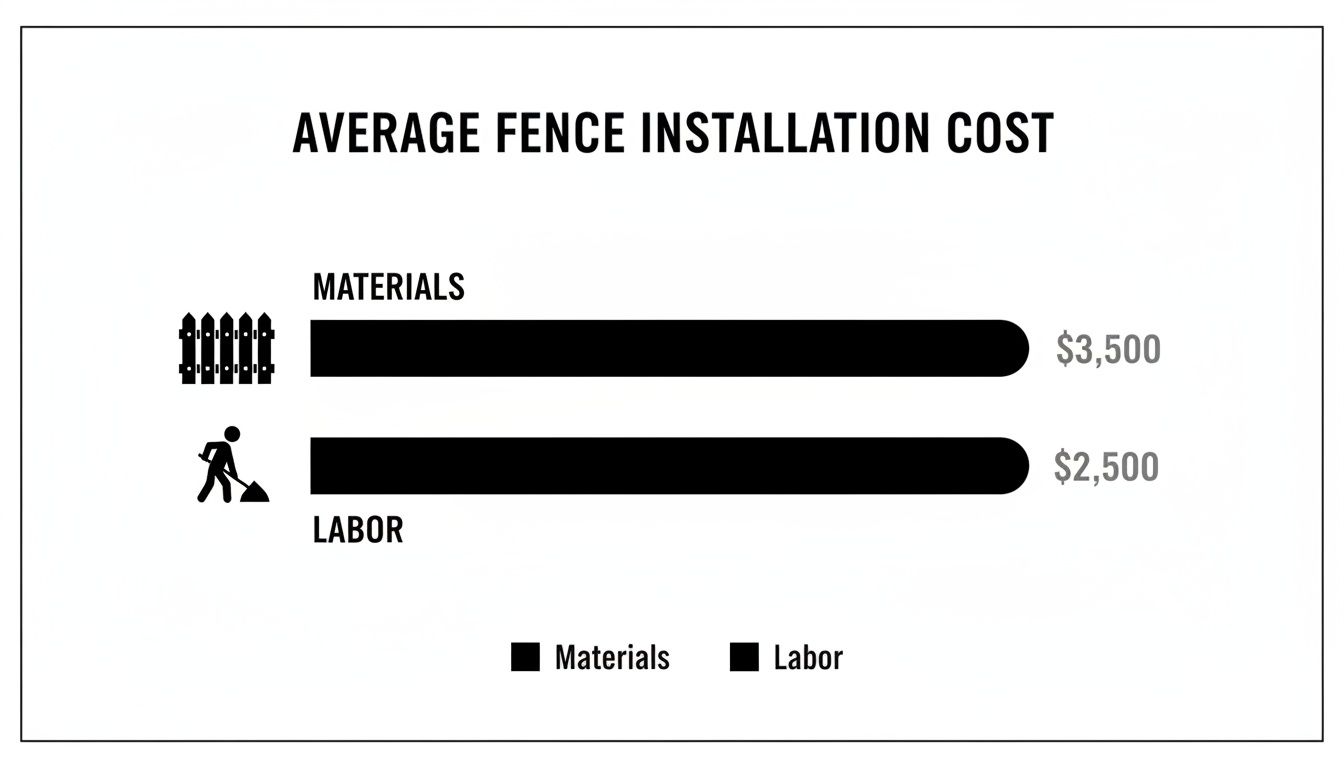
This chart gives you a general idea, but the material you select is what really drives that bigger "Materials" number up or down.
Wood: The Timeless, Natural Classic
There's a reason wood is a classic. For homeowners who want that truly authentic, rustic charm, nothing beats the real thing. Cedar, in particular, is a fantastic choice because it has natural oils that help it resist rot and insects. A wood picket fence has a warmth and texture that feels natural, blending beautifully with almost any landscape.
But that natural beauty comes with a catch: commitment. A wood fence is exposed to Connecticut's weather year-round, and it needs protection. You’ll have to plan on painting or staining it every few years to shield it from moisture and sun damage. If that maintenance is skipped, the wood can start to warp, crack, or decay, shortening its life. So while the initial cost might be lower than vinyl, you have to account for the cost of supplies and your own time down the road.
Composite: A High-Tech Hybrid
Composite fencing is a newer option designed to give you the best of both worlds. It’s made from a blend of wood fibers and recycled plastics, engineered to look like real wood without all the demanding maintenance. Just like vinyl, composite panels are incredibly durable and won't rot, warp, or attract pests.
The main draw here is the appearance—it offers a deeper, more wood-like texture that some people prefer over the smooth finish of vinyl. The trade-off? Composite is typically the most expensive option of the three, putting it at the high end of the market. It’s a great solution for those who want a wood look with zero upkeep and have the budget for it.
Of course, if you want similar durability at a more competitive price, modern vinyl fencing options offer a huge variety of styles that look fantastic.
Material Comparison Vinyl vs. Wood vs. Composite Picket Fences
Choosing between vinyl, wood, and composite really comes down to balancing your budget, your style, and how much time you want to spend on maintenance. To make it easier, here’s a side-by-side look at how they compare.
| Feature | Vinyl (PVC) | Wood (Cedar) | Composite |
|---|---|---|---|
| Initial Cost | Moderate to High | Low to Moderate | High |
| Maintenance | Almost none (occasional cleaning) | High (painting/staining every 2-3 years) | Very Low (occasional cleaning) |
| Durability | Excellent (won't rot, warp, or peel) | Good (with proper maintenance) | Excellent (resists rot, insects, and warping) |
| Lifespan | 20-30+ years | 15-20 years | 25+ years |
| Aesthetics | Clean, smooth, uniform finish | Natural, rustic, can be customized | Wood-like appearance and texture |
Ultimately, each material can be a great choice. If you prioritize long-term value and zero hassle, vinyl is hard to beat. If you love the authentic look of wood, just be ready for the upkeep. And if you want a wood look with vinyl's durability and have a flexible budget, composite is a strong contender.
Factors That Can Influence Your Final Fence Quote
When you get an estimate for a new white picket fence, the price you see is based on more than just the materials and the time it takes to put them together. Many small details about your specific project and property can shift the final cost up or down. Becoming familiar with these factors beforehand is the best way to understand your quote and avoid any surprises.
Think of the basic price as the starting point. Things like the height of the fence, the style you choose, and even the number of gates you need will customize that price. For example, a simple, straight-top 3-foot-high fence is always going to be more affordable than a 4-foot-high fence with a decorative curved top and fancy post caps. Each of those additions requires more material and more detailed labor.
And don't forget the gates. Every gate is its own small project, requiring special hardware for the latch and hinges, reinforced posts to handle the swinging motion, and extra labor to get the alignment just right.
How Your Property's Landscape Affects the Price
Every piece of land in Connecticut is unique, and the terrain itself is one of the biggest variables in the labor cost for a white picket fence. A perfectly flat, clear backyard is an ideal scenario for a quick installation. But that’s not always the case around here. Our crews are professionals who can tackle challenges that require more time and specialized work.
Here are a few common on-site factors that can add to the final bill:
- Slopes and Hills: You can't just tilt fence panels on a hill. To get it right, the fence needs to follow the shape of the land smoothly. This requires a professional technique that takes more time and skill to do properly.
- Tough Ground Conditions: From the rocky soil common in Hartford County to the dense clay in other areas, digging post holes isn't always easy. We often need to bring in specialized equipment like power augers to dig deep enough to get below the frost line, which adds to the labor time.
- Hidden Obstructions: It's not uncommon to find unexpected obstacles where the fence line is planned. Buried tree roots, old concrete from a previous project, or underground utility lines all require our installers to work carefully to remove or navigate around them safely.
A new fence isn't just a product you buy; it's a small construction project built on your property. A true professional's value is in their ability to solve these on-site challenges, ensuring your fence is not only beautiful but also built to last.
Don't Forget the Paperwork
Finally, there's the administrative side of things. Depending on where you live, your town's building department may require a permit before any work can start. This can involve submitting property plans and paying a fee.
While you can certainly handle this process yourself, an experienced local contractor can be a huge help. We are familiar with the specific permit requirements for towns all across Middlesex, New Haven, and New London counties, so we can make sure everything is filed correctly to keep your project on schedule. Sometimes, an older, existing fence might need reinforcement before a new section can be attached—knowing how to handle these kinds of fence repairs is just part of the job. This is the kind of support that leads to a smooth, headache-free installation from start to finish.
Sample Project Estimates for Your Home
Those per-foot prices we've been talking about are a great starting point, but they don't tell the whole story. To really get a feel for what a white picket fence costs, it helps to see how all those factors—material, layout, gates, and terrain—come together in real-world situations.
Let's walk through a couple of common project examples we handle all the time for homeowners across Connecticut, from Hartford down to New Haven County. Seeing these examples will help you start to picture where your own project might fall on the budget spectrum.
Scenario 1: Curb Appeal for a Suburban Front Yard
This is a classic project. A homeowner in a lovely suburban neighborhood wants that iconic white picket fence to frame their front yard. The goal here is purely for appearance—it’s all about boosting curb appeal and creating a timeless, welcoming look. The property is flat with easy access for our crew.
- Project Goal: Enhance curb appeal.
- Fence Length: 100 linear feet running across the front of the property.
- Material: Standard white vinyl for a crisp, clean look that requires zero maintenance.
- Design: A simple 3.5-foot height with one standard 4-foot wide walkway gate.
For a straightforward project like this, the homeowner is balancing timeless style with long-term convenience. By choosing vinyl, their investment is almost entirely upfront. They won't have to worry about the future costs and chores of painting or staining.
Based on these details, a project like this would likely fall in the $3,500 to $6,000 range. The final price will depend on the exact style of vinyl panel they choose and any other finishing touches. To see how different styles can totally transform a property, take a look through the work in our project gallery.
Scenario 2: A Safe Backyard for Kids and Pets
Here’s another request we get every week. A family with young kids and a new puppy needs to secure their backyard. The main goal is creating a safe, contained space where everyone can play without worry. This particular yard has a gentle slope and a few large tree roots we'll need to work around during the installation.
- Project Goal: Create a safe, enclosed play area.
- Fence Length: 250 linear feet to fully enclose the backyard.
- Material: Traditional cedar wood for its natural beauty and sturdy construction.
- Design: A taller 4-foot height with two gates—a wider one for the driveway and a standard one for easy backyard access.
In this case, the size of the project is the biggest factor driving the cost, as it requires much more material and labor. Choosing cedar gives them that classic charm but also comes with the understanding that it will need maintenance down the road to stay looking its best. The slope and tree roots will also add a bit more time to the labor estimate.
A large project like this would typically have an estimated cost in the $8,500 to $14,000 range. This reflects the greater length, the extra work needed to handle the terrain, and the hardware for two secure gates.
How to Get an Accurate and Free Fence Estimate
You've done the research. You have a solid grasp of the different materials, the factors that affect pricing, and what it takes to bring a classic white picket fence to your property. It’s clear this isn't just an expense; it's a worthwhile investment in your home's charm and security.
So, what’s the next step?
While a general fence installation cost estimator can give you a rough idea to start with, it's a bit like looking up a car's value online—it doesn't see the specific condition of your car. The only way to get a truly reliable price is with a professional, on-site consultation.
A professional estimate is so much more than just a number on a piece of paper. It’s a complete project plan. A seasoned expert can walk your property, spot challenges you might not see, listen to what you want to achieve, and build a detailed quote that leaves no room for guesswork.
This on-site meeting is invaluable. Here’s what you really get from it:
- Real-World Advice: You get personalized recommendations on the right materials and styles that actually fit your property and your budget.
- No-Surprise Pricing: An expert takes precise measurements, accounting for every corner and slope, which means the price you're quoted is the price you'll pay.
- Total Transparency: You receive a clear, itemized breakdown of every cost, giving you the confidence to move forward without any lingering questions.
Your Picket Fence Questions, Answered
It's natural to have a lot of questions when you start thinking about a new fence. We get them all the time from homeowners just like you across Connecticut, so we've put together some straightforward answers to the ones we hear most often.
How Much Value Does A Picket Fence Add To A Home?
There’s no magic formula for this, but the impact is real. A sharp-looking white picket fence completely transforms a home's curb appeal, and that first impression matters immensely to potential buyers.
While most exterior projects can see a return of 50-80% of their cost when you sell, a classic fence often lands on the higher side of that range. This is because it serves two purposes—it’s not just for looks, but it also clearly defines your property and adds a feeling of security. It’s an investment in both beauty and function.
Is It Cheaper To Install A Fence Myself?
On paper, doing it yourself seems like a great way to save money by cutting out labor costs. In reality, it can easily end up costing you more down the road. We have seen this happen many times.
Professional installation isn't just about speed; it's about getting the fundamentals right so your fence lasts for decades. Small mistakes can lead to big, expensive problems.
- Incorrect Post Depth: Here in Connecticut, posts absolutely must be set below the frost line. If they aren't, winter freezes will cause them to push up from the ground, ruining your fence line.
- Improper Spacing: Even being off by a small amount can cause fence panels to sag and look sloppy over time.
- Material Waste: One wrong cut or a mis-measured section often means you have to go back to the store to buy extra materials.
When you add up tool rentals, your own valuable time, and the potential cost of future repairs, having a professional handle it is almost always the smarter, more cost-effective choice.
How Long Does A Vinyl Picket Fence Last Compared To Wood?
This is where you see a major difference in long-term value. A modern vinyl picket fence is designed to last 20 to 30 years—sometimes even longer—with almost zero maintenance. You never have to paint it, and it will never rot or warp.
A traditional wood fence, like cedar, has a classic charm but requires a commitment. It can last 15 to 20 years, but only if you are diligent about painting or staining it every few years to protect it from our New England weather. Without that consistent upkeep, moisture and decay will shorten its life significantly.
Ready to get a precise, no-obligation quote for your property? The team at Connecticut Fence Works, LLC provides free, on-site estimates to help you plan with confidence. Visit us online to schedule your consultation.